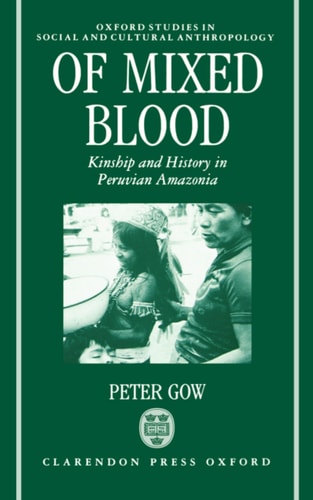
Of Mixed Blood: Kinship and History in Peruvian Amazonia
0
0
As an Amazon Associate and affiliate partner, Menrva Books earns from qualifying purchases. Learn more
Author Description
This book is an ethnography of the native people of the Bajo Urubamba river in Peruvian Amazonia. Gow attempts to account for the fact that the people of this region appear to be very acculturated when compared to better-known indigenous Amazonian peoples. He argues that when native people's claims are viewed from the perspective of their own values, and in the context of their creation of life through the productive transformation of the forest and the commodity economy, they can be seen to form a coherent part of kinship. Historical change is thus revealed as interior to the ongoing creation of kinship for native people, rather than alien to it.
Menrva's Summary
THE THESIS
This work investigates how indigenous populations in the Bajo Urubamba region of the Peruvian Amazon integrate historical change and acculturation into their own systems of kinship and social identity. Peter Gow, an anthropologist with extensive field experience in the region, challenges the assumption that acculturation represents a loss of indigenous culture. By analyzing the productive transformation of the forest and the commodity economy, he argues that these external influences are actively incorporated into the local framework of creating life and maintaining social relations. The book posits that historical processes are not external forces acting upon these people, but are instead internal components of their ongoing social reproduction.
THE SCOPE MAP
What You Will Find
- Detailed ethnographic analysis of the Bajo Urubamba river communities.
- Theoretical framework linking commodity economy participation to kinship structures.
- Primary source observations regarding the transformation of forest resources.
- Examination of how indigenous values shape the perception of historical change.
THE AUTHORITY PERSPECTIVE
Scholars in the field of Amazonian anthropology recognize this text as a significant contribution to the study of social change and indigenous agency. Readers frequently note the academic density of the prose, which requires a foundational understanding of anthropological theory to fully appreciate the author's arguments.
Page Count:
344
Publication Date:
1991-12-19
Publisher:
Clarendon Press
ISBN-10:
019827355X
ISBN-13:
9780198273554
South America
Social Science
Anthropology
Ethnography
Community Tags
Similar Books