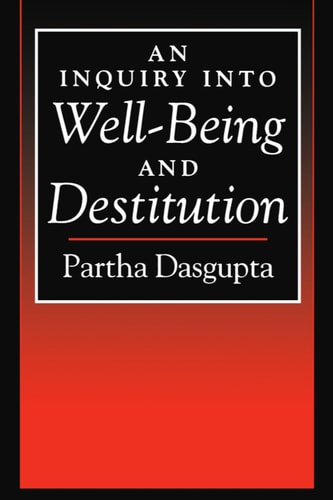
An Inquiry into Well-Being and Destitution
0
0
As an Amazon Associate and affiliate partner, Menrva Books earns from qualifying purchases. Learn more
Author Description
How should economic and social theory accommodate empirical facts about physical destitution, and how should governments respond to famines and hunger? This interdisciplinary book focuses on these and other questions about physical being. Dasgupta's aim here is to offer a description of destitution as it occurs among rural populations of the poor countries of Asia, Africa, and Latin America; to give an account of the forces at work which perpetuate destitution, and to offer prescriptions for both the public and private spheres of life.A central concern of the author has been to reconcile theoretical considerations with the empirical evidence that has been obtained in the several disciplines this work encompasses, including anthropology, demography, ecology, geography, and philosophy. The entire discussion is designed to provide a philosophy for human well-being that can guide public policy in poor countries. Therefore, the role of the State, of communities, of households, and of individuals is studied in considerable detail.The author reveals an empirical link between greater political and civil liberties and improvements in life expectancy at birth, national income per capita, and infant survival rates. He identifies patterns of asset redistribution that promote economic growth by raising labor productivity, and argues that democratic participation in the design of public policies is not only intrinsically valuable, but has strong instrumental virtues: it allows privately held information to be put into effective use. Dasgupta presents evidence to show that significant reductions in military budgets would free the resources needed for the satisfaction of citizens' basic economic needs, and he provides guidance for the motivation and necessary focus of governments. He also looks at the allocation of food, work, health care, education, and income across genders, age groups, and orders of birth. He explores the findings of nutritionists on the link between food needs
Menrva's Summary
THE THESIS
This work investigates the complex interplay between economic theory, social structures, and the empirical realities of physical destitution in developing nations. Partha Dasgupta, a distinguished economist, synthesizes data from anthropology, demography, ecology, and philosophy to construct a comprehensive framework for human well-being. He argues that political and civil liberties are intrinsically linked to economic growth and survival rates, proposing that democratic participation and resource reallocation are essential for alleviating poverty. The text serves as a guide for policymakers to address the systemic causes of hunger and inequality through informed state and community action.
THE SCOPE MAP
What You Will Find
- Analysis of destitution across rural populations in Asia, Africa, and Latin America.
- Examination of the correlation between civil liberties and national health indicators.
- Evaluation of asset redistribution strategies to enhance labor productivity.
- Assessment of resource allocation regarding food, health care, and education across demographics.
THE AUTHORITY PERSPECTIVE
Experts recognize this work as a foundational interdisciplinary text that bridges the gap between abstract economic theory and the practical realities of global poverty. Readers frequently note the academic density of the prose, which requires a firm grasp of development economics to fully appreciate the author's nuanced policy prescriptions.
Page Count:
680
Publication Date:
1995-08-24
Publisher:
Clarendon Press
ISBN-10:
0198288352
ISBN-13:
9780198288350
Economics
Human rights
Households
Malnutrition
Developing Countries
Public Policy
Sociology
Quality of Life
Community Tags
Similar Books