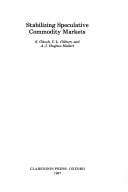
Stabilizing Speculative Commodity Markets
0
0
As an Amazon Associate and affiliate partner, Menrva Books earns from qualifying purchases. Learn more
Author Description
The collapse of the International Tin Agreement has led to the belief that commodity price intervention is unnecessary and unlikely to succeed. However, as long as Third World producers continue to experience difficulties in obtaining adequate credit, there will be a need for some form of international commodity policy, and stabilization schemes will remain candidates. This book discusses the formulation of such schemes, developing a mathematical model for commodity markets and examining its welfare effects and implications for intervention.
Menrva's Summary
THE THESIS
This book investigates whether international commodity price stabilization schemes remain viable and necessary tools for supporting developing economies in the wake of the International Tin Agreement collapse. The authors, A. J. Hughes Hallett, C. L. Gilbert, and S. Ghosh, utilize rigorous economic modeling to evaluate the welfare effects of market intervention. By analyzing the credit constraints faced by producers in developing nations, the text provides a framework for understanding how policy can mitigate volatility in global commodity markets.
THE SCOPE MAP
What You Will Find
- A mathematical model for analyzing commodity market dynamics and price fluctuations
- An evaluation of the welfare implications of various intervention strategies
- Analysis of the credit accessibility challenges faced by Third World commodity producers
- A critical review of historical stabilization schemes and their failure points
THE AUTHORITY PERSPECTIVE
Experts recognize this work as a technical contribution to the field of international trade economics, particularly regarding the debate over market intervention. Readers frequently note the mathematical density of the prose, which requires a strong background in economic theory to fully grasp the proposed models.
Page Count:
456
Publication Date:
1987-10-08
Publisher:
Oxford University Press
ISBN-10:
0198284721
ISBN-13:
9780198284727
Economics
Finance
Public Policy
Commodities
Speculation
International Trade
Community Tags
Similar Books