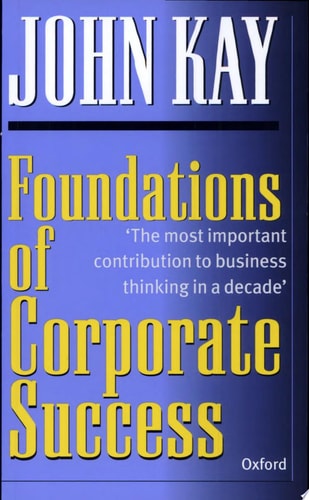
Foundations of Corporate Success: How Business Strategies Add Value
0
0
As an Amazon Associate and affiliate partner, Menrva Books earns from qualifying purchases. Learn more
Author Description
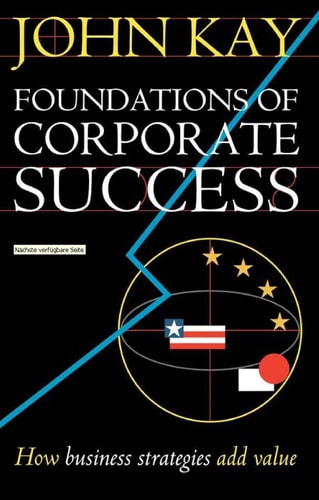
How did BMW recover from the edge of bankruptcy to become on of Europe's strongest companies? Why did Saatchi and Saatchi's global strategy bring the company to its knees? Why has Philips's outstanding record in innovation not been translated into success in the market? What can be learnt from the marriage contract about the conduct of commercial negotiations? These are some of the questions addressed as John Kay asks 'What makes a business successful?' Drawing on his own business experience and on concepts in economics, legal theory, and sociology, the author presents a fresh approach to questions of business strategy. He rejects the military analogy which underpins much strategic thinking, in which success depends on size and share, on vision and leadership, on shifting patterns of mergers and alliances. John Kay argues that outstanding businesses derive their strength from a distinctive structure of relationships with employees, customers, and suppliers, and explains why continuity and stability in these relationships is essential for a flexible and co-operative response to change. By integrating organizational and financial perspectives on the performance of the firm, Kay not only gives insights into the creation of effective business strategies, but sheds light on the success - and failure - of national economies. As the single market develops, this book - full of insight and rigour, yet lively in style - is probably the most important European contribution to strategic thinking for many years. It will be vital reading for all who want to understand what distinguishes the successful company.
Menrva's Summary
THE THESIS
This book investigates the fundamental drivers of corporate success by challenging traditional military-style strategic models in favor of relationship-based organizational structures. John Kay, an economist with extensive experience in business theory and practice, synthesizes concepts from legal theory, sociology, and economics to construct his argument. He posits that long-term commercial viability stems from stable, distinctive relationships with employees, customers, and suppliers rather than mere market share or aggressive expansion. By analyzing the performance of various firms, Kay provides a framework for understanding how organizational architecture dictates economic outcomes.
THE SCOPE MAP
What You Will Find
- Comparative analysis of corporate successes and failures, including case studies of BMW, Saatchi and Saatchi, and Philips.
- A critique of conventional strategic thinking that relies on military metaphors and size-based metrics.
- A framework for evaluating the role of organizational relationships in maintaining flexibility and cooperation.
- Integration of financial and sociological perspectives to explain firm performance and national economic trends.
THE AUTHORITY PERSPECTIVE
Experts and business scholars frequently cite this work as a foundational text for understanding the structural underpinnings of corporate strategy. Readers often note the academic rigor of the prose, which balances theoretical economic concepts with practical, real-world business applications.
Page Count:
432
Publication Date:
2007-01-01
Publisher:
Oxford Paperbacks
ISBN-10:
019828988X
ISBN-13:
9780198289883
Business
Economics
Management
Strategic Planning
Business planning
Success in business
Strategy
Corporate Finance
Organizational effectiveness