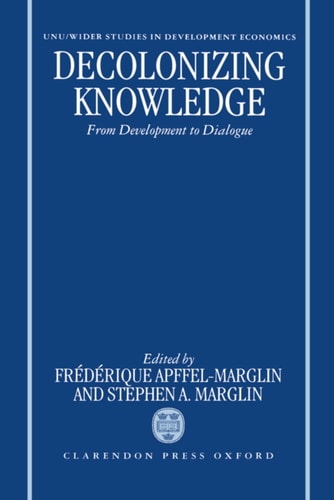
Decolonizing Knowledge: From Development to Dialogue
0
0
As an Amazon Associate and affiliate partner, Menrva Books earns from qualifying purchases. Learn more
Author Description
Development failures, environmental degradation and social fragmentation can no longer be regarded as "side effects." They are the toxic consequences of pretensions that the modern Western view of knowledge is a universal neutral view, applicable to all people at all times. This work argues that the linear evolutionary paradigm of development emerging from the modern Western view of knowledge is a contemporary form of colonialism. The work proposes a pluralistic vision and a decolonization of knowledge: the replacement of one-way transfers of knowledge and technology by dialogue and mutual learning. It will be of interest to scholars of development studies, sociology, and anthropology.
Menrva's Summary
THE THESIS
This work investigates whether the modern Western paradigm of knowledge acts as a form of contemporary colonialism that necessitates a shift toward pluralistic dialogue. The authors, Frédérique Apffel-Marglin and Stephen A. Marglin, challenge the assumption that Western scientific knowledge is universal and neutral. By analyzing the systemic failures of development projects, they argue that these outcomes are not accidental side effects but inherent consequences of imposing a singular, linear evolutionary framework on diverse cultures. The text advocates for replacing top-down technology transfers with a model of mutual learning and cultural exchange.
THE SCOPE MAP
What You Will Find
- Analysis of the relationship between modern development paradigms and historical colonialism
- Critique of the Western assumption of knowledge as a neutral, universal construct
- Examination of social fragmentation and environmental degradation as systemic outcomes
- Theoretical framework for a pluralistic approach to global knowledge exchange
THE AUTHORITY PERSPECTIVE
Scholars in development studies and anthropology frequently cite this text as a critical contribution to the discourse on post-development theory. Readers often note the academic density of the prose, which requires a foundational understanding of sociological and economic theory to fully engage with the authors' arguments.
Page Count:
408
Publication Date:
1996-07-25
Publisher:
Clarendon Press
ISBN-10:
0198288840
ISBN-13:
9780198288848
Anthropology
Sociology
Community Tags
Similar Books