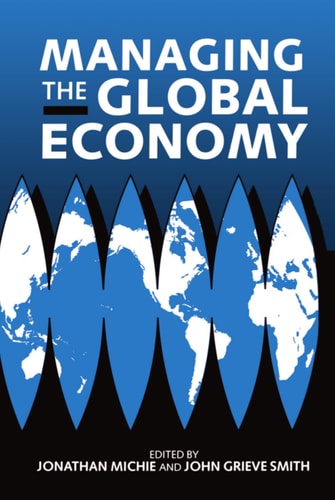
Managing the Global Economy
0
0
As an Amazon Associate and affiliate partner, Menrva Books earns from qualifying purchases. Learn more
Author Description
The demise of the post-war era of full employment has been followed by more than 20 years of global instability. The world economy enters the 21st century with the industrial world divided between the European Union, the North American Free Trade Area, and the Pacific Rim countries. This tripolar division could either form the basis for negotiation and co-operation, or else the sort of instability witnessed in the prelude to the two world wars.Managing the Global Economy describes the key trends in the world economy, and indicates what new institutional arrangements might be appropriate - but stresses that action will not be taken until the prevailing fatalistic economic ideology is discarded. It demonstrates that the global financial markets were created by financial institutions as governments freed finaincial markets from their control. It documents how far international co-operation has freed the markets and limited the power of governments, and indicates how these priorities could be reversed.18 leading economists, economic commentators, proactitionaers, and policy-makers contribute to a book which will make a major impact on policy debates.
Menrva's Summary
THE THESIS
Can the global economy transition from a state of instability and fragmented power toward a model of international cooperation and effective governance? The authors, James Grieve Smith and Jonathan Michie, assemble a collection of insights from 18 prominent economists and policy-makers to examine the erosion of post-war full employment and the rise of global financial volatility. The text argues that the current economic landscape is defined by a tripolar division between the European Union, the North American Free Trade Area, and the Pacific Rim, suggesting that institutional reform is necessary to reclaim government agency from deregulated financial markets.
THE SCOPE MAP
What You Will Find
- Analysis of the tripolar economic division between the EU, NAFTA, and the Pacific Rim.
- Documentation of the historical deregulation of global financial markets by national governments.
- Evaluation of the impact of international cooperation on the erosion of sovereign government power.
- Proposals for new institutional arrangements to replace prevailing fatalistic economic ideologies.
THE AUTHORITY PERSPECTIVE
Experts and policy analysts recognize this work as a critical contribution to the debate on global economic governance and the limitations of neoliberal policy. Readers frequently note the academic density of the prose and the focus on structural reform as a challenge to contemporary economic orthodoxy.
Page Count:
376
Publication Date:
1995-04-27
Publisher:
Oxford University Press
ISBN-10:
0198289693
ISBN-13:
9780198289692
Economics
Public Policy
Finance
Global Economy
Community Tags
Similar Books