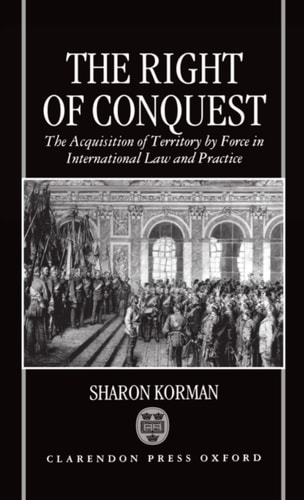
The Right of Conquest: The Acquisition of Territory by Force in International Law and Practice
0
0
As an Amazon Associate and affiliate partner, Menrva Books earns from qualifying purchases. Learn more
Author Description
The notion that a state that emerges victorious in war is entitled to claim sovereignty over conquered territory in virtue of military victory or conquest was, until recently, a recognized principle of international law. This study is an inquiry into the place of the right of conquest in international relations since the early sixteenth century and the causes and consequences of its demise in the twentieth.Part 1 examines the theoretical foundation of the right of conquest and its historical importance, particularly in the establishment of the European colonial empires. Part 2 shows how the First World War, which led to the rise of the principle of self-determination and to calls for the prohibition of aggressive war, prompted the reconstruction of international law and consequent rejection of the right of conquest. The cases of East Jerusalem, the Golan Heights, Goa, the Falkland Islands, East Timor and Kuwait are used to evaluate the content and effectiveness of the modern law. The conclusion examines the problems posed by the rejection of the right of conquest from the standpoints of international order and justice.The Right of Conquest is a leading authority on annexation in international law, relied on by states as well as scholars. It has been cited in government submissions to the International Court of Justice and by the Venice Commission of the Council of Europe in its legal opinion on Russia's annexation of Crimea in 2014.
Menrva's Summary
THE THESIS
This book investigates the historical evolution and eventual legal prohibition of the right of conquest as a legitimate means for states to acquire territory through military force. Sharon Korman, a scholar of international relations and law, provides a rigorous analysis of how the international community transitioned from accepting conquest as a standard practice to outlawing it in the twentieth century. The work utilizes a combination of historical analysis and legal theory to trace the shift from colonial-era norms to the modern framework established by the principle of self-determination and the prohibition of aggressive war. By examining the theoretical foundations of sovereignty, Korman argues that the rejection of conquest creates complex challenges for maintaining international order and justice in contemporary conflicts.
THE SCOPE MAP
What You Will Find
- Historical analysis of the right of conquest from the sixteenth century through the modern era.
- Examination of the impact of the First World War on the reconstruction of international legal norms.
- Case studies including East Jerusalem, the Golan Heights, Goa, the Falkland Islands, East Timor, and Kuwait.
- Evaluation of the effectiveness of modern international law regarding annexation and territorial integrity.
THE AUTHORITY PERSPECTIVE
Legal scholars and government bodies recognize this work as a foundational authority on the law of annexation and territorial acquisition. Experts frequently cite the text for its comprehensive treatment of the legal transition from historical conquest to the modern prohibition of force.
Page Count:
352
Publication Date:
1996-12-05
Publisher:
Clarendon Press
ISBN-10:
0198280076
ISBN-13:
9780198280071
History
International Law
Diplomacy
War
Sovereignty
Community Tags
Similar Books