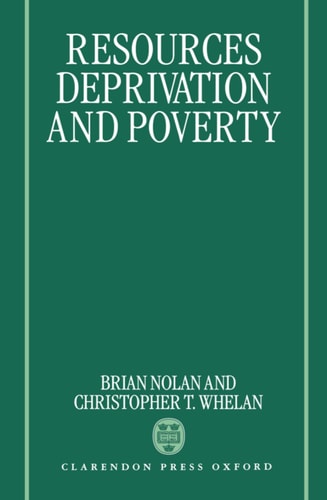
Resources, Deprivation, and Poverty
0
0
As an Amazon Associate and affiliate partner, Menrva Books earns from qualifying purchases. Learn more
Author Description
The core issue of this book is how to define and measure poverty in relatively rich countries in a way which is valid, meaningful in the context, and valuable for policy-making. The authors concentrate on the identification of the poor, rather than the subsequent aggregation of the statistics to derive an overall index of poverty--which is the focus of most recent literature. They show that poverty in developed countries cannot be understood and measured simply using current income. Those who are excluded from participation in society can be more accurately identified if broader measures of resources and direct idicators of deprivation are used. The issues are illustrated by data from a specially designed survey of a large representative sample of Irish households.
Menrva's Summary
THE THESIS
This book investigates how to accurately define and measure poverty within affluent nations to ensure policy-making remains valid and meaningful. The authors, Brian Nolan and Christopher T. Whelan, utilize their expertise in social policy and economics to challenge the traditional reliance on income-based metrics. They argue that poverty is a multidimensional state that requires a broader framework incorporating direct indicators of deprivation and resource access to properly identify those excluded from societal participation.
THE SCOPE MAP
What You Will Find
- A critical evaluation of income-based poverty measurement versus multidimensional resource analysis.
- Methodologies for identifying poverty through direct indicators of social exclusion and deprivation.
- Empirical evidence derived from a large-scale, representative survey of Irish households.
- A policy-oriented framework designed to improve the identification of the poor in developed economies.
THE AUTHORITY PERSPECTIVE
Experts recognize this work as a significant contribution to the field of poverty research for its shift away from aggregate statistical indices toward individual identification. Scholars frequently cite the text for its rigorous application of survey data to validate the necessity of multidimensional poverty metrics.
Page Count:
272
Publication Date:
1996-08-01
Publisher:
Clarendon Press
ISBN-10:
0198287852
ISBN-13:
9780198287858
Economics
Social Science
Sociology
Poverty
Public Policy
Community Tags
Similar Books