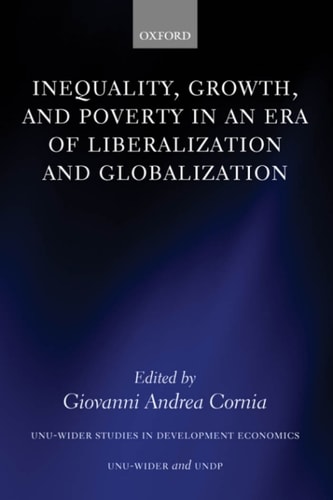
Inequality, Growth, and Poverty in an Era of Liberalization and Globalization
0
0
As an Amazon Associate and affiliate partner, Menrva Books earns from qualifying purchases. Learn more
Author Description
Within-country income inequality has risen since the early 1980s in most of the OECD, all transitional, and many developing countries. More recently, inequality has risen also in India and nations affected by the Asian crisis. Altogether, over the last twenty years, inequality worsened in 70 per cent of the 73 countries analysed in this volume, with the Gini index rising by over five points in half of them. In several cases, the Gini index follows a U-shaped pattern, with the turn-around point located between the late 1970s and early 1990s. Where the shift towards liberalization and globalization was concluded, the right arm of the U stabilized at the 'steady state level of inequality' typical of the new policy regime, as observed in the UK after 1990. Mainstream theory focusing on rises in wage differentials by skill caused by either North-South trade, migration, or technological change poorly explains the recent rise in income inequality. Likewise, while the traditional causes of income polarization-high land concentration, unequal access to education, the urban bias, the 'curse of natural resources'-still account for much of cross-country variation in income inequality, they cannot explain its recent rise. This volume suggests that the recent rise in income inequality was caused to a considerable extent by a policy-driven worsening in factorial income distribution, wage spread and spatial inequality. In this regard, the volume discusses the distributive impact of reforms in trade and financial liberalization, taxation, public expenditure, safety nets, and labour markets. The volume thus represents one of the first attempts to analyse systematically the relation between policy changes inspired by liberalization and globalization and income inequality. It suggests that capital account liberalization appears to have had-on average-the strongest disequalizing effect, followed by domestic financial liberalization, labour market deregulation, and tax reform. Trade libe
Menrva's Summary
THE THESIS
This volume investigates the causal relationship between policy-driven liberalization and globalization and the widespread rise in within-country income inequality observed since the 1980s. Giovanni Andrea Cornia, a prominent economist associated with WIDER, synthesizes cross-country data to challenge mainstream theories that attribute inequality solely to technological change or trade-related wage differentials. The work argues that specific policy reforms—including financial liberalization, labor market deregulation, and tax restructuring—have significantly worsened factorial income distribution.
THE SCOPE MAP
What You Will Find
- Comparative analysis of 73 countries across OECD, transitional, and developing economies.
- Empirical assessment of the Gini index trends from the late 1970s to the early 2000s.
- Evaluation of the distributive impacts of trade, financial, and fiscal policy reforms.
Scope Limits
- The analysis focuses primarily on policy-driven drivers of inequality rather than long-standing structural factors like land concentration or natural resource dependence.
THE AUTHORITY PERSPECTIVE
Experts recognize this volume as a foundational empirical study for understanding the distributive consequences of the Washington Consensus and related policy shifts. Readers frequently note the academic density of the prose, which provides a rigorous, data-heavy framework for students and researchers of development economics.
Page Count:
464
Publication Date:
2004-01-01
Publisher:
Oxford University Press
ISBN-10:
0191533882
ISBN-13:
9780191533884
Economics
Social Science
Public Policy
Principles of Macroeconomics
Globalization
Poverty
Community Tags
Similar Books