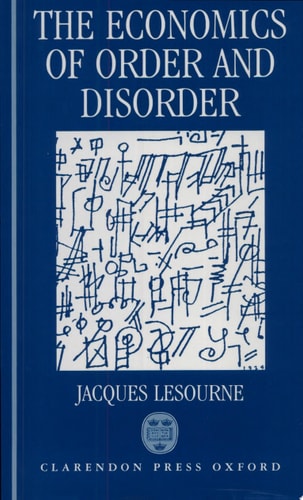
The Economics of Order and Disorder: The Market as Organizer and Creator
0
0
As an Amazon Associate and affiliate partner, Menrva Books earns from qualifying purchases. Learn more
Author Description
This work analyzes the operation and demise of institutions in economics--starting with the notion of self-organization--taking into account the intervention of history, chance, necessity, and will. Beginning with the theory of microeconomics, Lesourne builds precise models based on explicit hypotheses and draws out the significance of the propositions obtained. Using systems, evolutionary and general equilibrium theories, as well as literature on institutional economics, Lesourne steps out of the present conceptual framework of microeconomics.
Menrva's Summary
THE THESIS
This work investigates the mechanisms behind the formation, operation, and eventual dissolution of economic institutions through the lens of self-organization. Jacques Lesourne, a prominent economist, utilizes a rigorous mathematical and theoretical framework to challenge traditional microeconomic boundaries. By integrating history, chance, and human agency into his models, he argues that economic systems are dynamic entities that evolve beyond static equilibrium. The text systematically builds upon explicit hypotheses to demonstrate how market structures emerge from complex interactions.
THE SCOPE MAP
What You Will Find
- Theoretical models of self-organization within market systems
- Integration of evolutionary theory and general equilibrium analysis
- Examination of the role of historical contingency and chance in institutional development
- Critical assessment of institutional economics literature
THE AUTHORITY PERSPECTIVE
Experts recognize this text as a sophisticated bridge between classical microeconomic theory and more modern, complex systems approaches. Readers frequently note the high level of mathematical and conceptual density required to fully engage with the author's proposed models.
Page Count:
224
Publication Date:
1992-05-07
Publisher:
Clarendon Press
ISBN-10:
0198287399
ISBN-13:
9780198287391
Economics
Microeconomics
Systems Theory
Evolutionary Economics
Community Tags
Similar Books