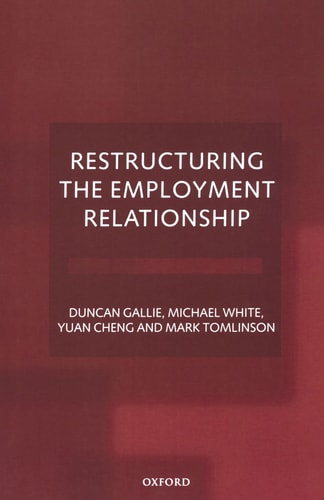
Restructuring The Employment Relationship
0
0
As an Amazon Associate and affiliate partner, Menrva Books earns from qualifying purchases. Learn more
Author Description
This masterly new study presents the first large-scale empirical analysis of the changes in British work experiences and employment relationships between the 1980s and 1990s. Drawing on the Employment in Britain survey—a national survey providing the richest source of evidence to date about individuals' experience of employment—it examines the impact of new technologies, the emergence of new management policies, the changing forms of employment contract, and the growth of job insecurity on people's experience of employment. The authors focus on the implications these developments have for the ways in which skills and work tasks have been changing, the nature of control at work, the degree of participation in decision-making, and the flexibility demanded at work. They assess whether there has been a tendency towards either a polarization or convergence of employment experiences between men and women, and between occupational classes. They offer fresh insight into how the changing quality of work in recent years has affected employee's involvement in their jobs and organizations, the stress they experience at work, and the propensity for absenteeism and staff turnover. While the study provides strong evidence of a marked trend towards up skilling, the authors take issue with the argument that a new type of employment relationship is emerging, arguing instead that the restructuring of the employment relationship has, in fact, reinforced traditional lines of division in the workforce.
Menrva's Summary
THE THESIS
This study investigates whether the restructuring of the British employment relationship between the 1980s and 1990s fundamentally altered the nature of work or merely reinforced existing social and occupational divisions. Duncan Gallie and his colleagues utilize data from the Employment in Britain survey to analyze the impact of technological advancement, management policy shifts, and the rise of job insecurity. The authors argue that while there is clear evidence of upskilling, the structural changes did not create a new employment paradigm but rather solidified traditional workforce inequalities.
THE SCOPE MAP
What You Will Find
- Empirical analysis of British work experiences spanning the 1980s to the 1990s.
- Examination of management policies, employment contracts, and technological integration.
- Quantitative data derived from the Employment in Britain survey.
- Assessment of labor trends including job insecurity, absenteeism, and staff turnover.
THE AUTHORITY PERSPECTIVE
Experts recognize this work as a foundational empirical study for understanding the evolution of the British labor market during the late twentieth century. Scholars frequently cite the text for its rigorous use of survey data to challenge prevailing theories regarding the transformation of the modern workplace.
Page Count:
368
Publication Date:
1998-05-31
Publisher:
Oxford Univ Pr
ISBN-10:
0198294417
ISBN-13:
9780198294412
Economics
Business
Labor Studies
Management
Employees
Great Britain
Hours Of Labor
Sociology
Women
British History
Community Tags
Similar Books