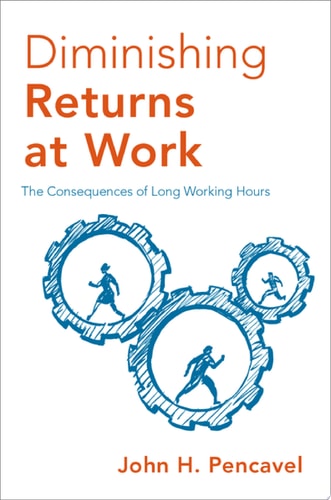
Diminishing Returns at Work: The Consequences of Long Working Hours
0
0
As an Amazon Associate and affiliate partner, Menrva Books earns from qualifying purchases. Learn more
Author Description
The relationship between the number of hours worked and productivity has long fascinated economists and management. It is a central component of the production function that translates inputs to outputs. While increasing the number of hours someone works may increase output, this incisive book demonstrates that there are diminishing returns to long working hours.John H. Pencavel provides an overview of how the length of working hours evolved from the 19th century to today and how the number of working hours affects work performance and other outcomes, including health, well-being, and wages. Diminishing Returns at Work provides a brief history of working hours both in the United States and Britain, including the influence of trade unions pushing for shorter hours of work, the tension with employers who resisted reducing hours, and the influence of legislation and custom. Pencavel discusses various conceptual frameworks for specifying production functions that measure the relationship between inputs and outputs and develops an alternative approach to estimate actual relationships through a reevaluation of classic studies, including the productivity of munitions workers in Britain during the First and Second World Wars and plywood mills in Washington during the 1980s among others.The declining effectiveness of long hours is manifested not only in marketable output but also in a rising probability of ill-health and accidents, and evidence of this has been found both for blue-collar workers and for white-collar workers. In short, shorter hours of work might benefit both firms and workers.
Menrva's Summary
THE THESIS
This book investigates the empirical relationship between extended working hours and worker productivity to determine the point at which additional labor yields diminishing returns. John H. Pencavel, an economist specializing in labor markets, utilizes historical data and industrial case studies to challenge the assumption that increased hours consistently equate to higher output. He argues that excessive work duration negatively impacts both firm productivity and individual employee well-being, suggesting that shorter work cycles may be more efficient for all parties involved.
THE SCOPE MAP
What You Will Find
- Historical analysis of labor hours in the United States and Britain from the 19th century to the present.
- Evaluation of production function models used to measure labor input versus output.
- Reassessment of classic industrial studies, including munitions manufacturing during the World Wars and plywood milling in the 1980s.
- Examination of the correlation between long hours and increased rates of workplace accidents and health issues.
Scope Limits
- The analysis focuses primarily on industrial and manufacturing contexts rather than modern digital or creative service sectors.
- The text does not provide a comprehensive guide for individual time management or personal productivity hacks.
THE AUTHORITY PERSPECTIVE
Experts recognize this work as a rigorous economic examination of labor efficiency that provides necessary historical context for modern workplace debates. Readers frequently note the academic density of the prose, which relies heavily on statistical reevaluation and historical documentation to support its conclusions.
Page Count:
268
Publication Date:
2018-06-14
Publisher:
Oxford University Press
ISBN-10:
0190876166
ISBN-13:
9780190876166
Economics
Special Topics
Labor Studies
Management
Business History
Workplace Productivity
Public Policy
Great Britain
Hours Of Labor
Community Tags
Similar Books