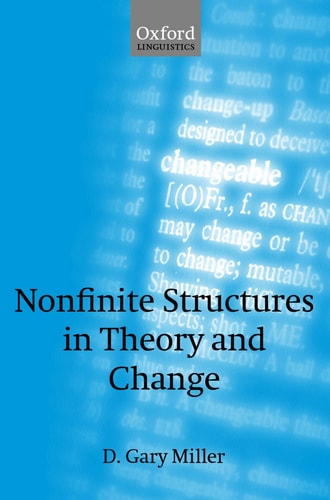
Nonfinite Structures in Theory and Change
0
0
As an Amazon Associate and affiliate partner, Menrva Books earns from qualifying purchases. Learn more
Author Description
This book seeks to answer the questions: why do grammars change, and why is the rate of such change so variable? A principal focus is on changes in English between the Anglo-Saxon and early modern periods. The author frames his analysis in a comparative framework with extended discussions of language change in a wide range of other Indo-European languages. He deploys Chomsky's minimalist framework in a fruitful marriage of comparative and theoretical linguistics within an argument that will be accessible to practitioners in both fields.
Menrva's Summary
THE THESIS
This book investigates the underlying mechanisms of grammatical change and the reasons for the varying rates at which these changes occur across different languages. D. Gary Miller, a scholar in historical linguistics, utilizes a comparative framework to examine the evolution of nonfinite structures. By applying the principles of Chomsky's minimalist program, the author constructs an argument that bridges the gap between theoretical linguistics and historical language analysis.
THE SCOPE MAP
What You Will Find
- Analysis of English grammatical evolution from the Anglo-Saxon period through the early modern period.
- Comparative studies of nonfinite structures across a diverse range of Indo-European languages.
- Application of the minimalist framework to explain syntactic shifts and developmental patterns.
- Theoretical arguments regarding the variability of linguistic change rates over time.
THE AUTHORITY PERSPECTIVE
Experts in the field recognize this work as a significant contribution to the study of diachronic syntax and comparative linguistics. Readers frequently note the academic density of the prose, which serves as a rigorous resource for advanced students and professional linguists.
Page Count:
488
Publication Date:
2002-05-23
Publisher:
Oxford University Press
ISBN-10:
0198299605
ISBN-13:
9780198299608
Grammar
Linguistics