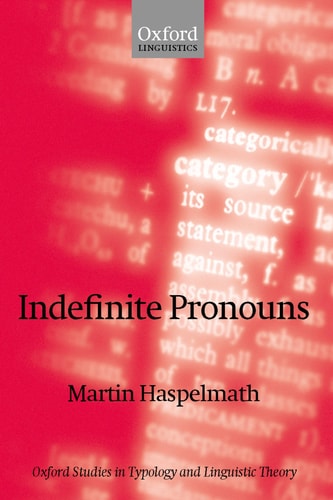
Indefinite Pronouns: Oxford Studies in Typology & Linguistic Theory
0
0
As an Amazon Associate and affiliate partner, Menrva Books earns from qualifying purchases. Learn more
Author Description
This is an open access title available under the terms of a CC BY-NC-ND 4.0 International licence. It is free to read at Oxford Scholarship Online and offered as a free PDF download from OUP and selected open access locations.Most of the world's languages have indefinite pronouns, that is, expressions such as someone, anything, and nowhere. Martin Haspelmath presents the first comprehensive and encyclopaedic investigation of indefinite pronouns in the languages of the world, mapping out the range of variation in their functional and formative properties. He shows that cross-linguistic diversity is severely constrained by a set of implicational universals and by a number of unrestricted universals.The author treats his subject matter broadly within the Humboldt-Greenberg tradition of language typology, but also considers the contribution of other theoretical approaches to an understanding of the functional and formal properties of indefinite pronouns. The book is organized into four logically ordered steps: selection of a part of grammar-- indefinite pronouns--that can be identified across languages by formal and functional criteria; investigation of the properties of indefinite pronouns in a world-wide sample of forty languages; formulation of generalizations that emerge from the data, summarized in the form of an implicational map; and theoretically informed explanations of the generalizations, which go beyond system-internal statements, appealing to cognitive semantics, functional pressures, and language change (especially grammaticalization).
Menrva's Summary
THE THESIS
This book investigates the cross-linguistic diversity and functional properties of indefinite pronouns to determine the universal constraints governing their formation. Martin Haspelmath, a prominent linguist, utilizes the Humboldt-Greenberg tradition of language typology to analyze how indefinite pronouns function across a diverse sample of forty languages. By examining both formal and functional criteria, the author establishes a set of implicational universals that explain why certain patterns of pronoun usage appear consistently across disparate linguistic families.
THE SCOPE MAP
What You Will Find
- A comprehensive survey of indefinite pronouns across a global sample of forty distinct languages.
- An implicational map detailing the functional and formative properties of pronoun systems.
- Theoretical explanations rooted in cognitive semantics, functional pressures, and grammaticalization.
- A structured methodology for identifying grammatical categories across different language families.
THE AUTHORITY PERSPECTIVE
Experts recognize this work as a foundational text in the field of linguistic typology due to its rigorous cross-linguistic data analysis. Readers frequently note the academic density of the prose, which is intended for scholars and advanced students of linguistics.
Page Count:
384
Publication Date:
2001-04-19
Publisher:
Clarendon Press
ISBN-10:
019829963X
ISBN-13:
9780198299639
Linguistics
Language
Reference
Academic
Community Tags
Similar Books