On Civilization's Edge: A Polish Borderland in the Interwar World
0
0
As an Amazon Associate and affiliate partner, Menrva Books earns from qualifying purchases. Learn more
Author Description
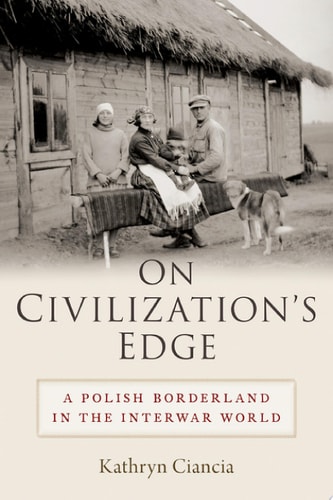
As a resurgent Poland emerged at the end of World War I, an eclectic group of Polish border guards, state officials, military settlers, teachers, academics, urban planners, and health workers descended upon Volhynia, an eastern borderland province that was home to Ukrainians, Poles, and Jews. Its aim was not simply to shore up state power in a place where Poles constituted an ethnic minority, but also to launch an ambitious civilizing mission that would transform a poor Russian imperial backwater into a region that was at once civilized, modern, and Polish. Over the next two decades, these men and women recast imperial hierarchies of global civilization-in which Poles themselves were often viewed as uncivilized-within the borders of their supposedly anti-imperial nation-state.As state institutions remained fragile, long-debated questions of who should be included in the nation re-emerged with new urgency, turning Volhynia's mainly Yiddish-speaking towns and Ukrainian-speaking villages into vital testing grounds for competing Polish national visions. By the eve of World War II, with Nazi Germany and the Soviet Union growing in strength, schemes to ensure the loyalty of Jews and Ukrainians by offering them a conditional place in the nation were replaced by increasingly aggressive calls for Jewish emigration and the assimilation of non-Polish Slavs.Drawing on research in local and national archives across four countries and utilizing a vast range of written and visual sources that bring Volhynia to life, On Civilization's Edge offers a highly intimate story of nation-building from the ground up. We eavesdrop on peasant rumors at the Polish-Soviet border, read ethnographic descriptions of isolated marshlands, and scrutinize staged photographs of everyday life. But the book's central questions transcend the Polish case, inviting us to consider how fears of national weakness and competitions for local power affect the treatment of national minorities, how more inclusive d
Menrva's Summary
THE THESIS
How did the Polish state attempt to construct a modern national identity within the ethnically diverse and historically neglected borderland province of Volhynia during the interwar period? Kathryn Ciancia, an associate professor of history, utilizes extensive archival research from four countries to argue that the Polish civilizing mission in Volhynia was a complex, often contradictory project that sought to redefine Poland's place in the global hierarchy of civilization while simultaneously grappling with the inclusion and exclusion of Jewish and Ukrainian populations.
THE SCOPE MAP
What You Will Find
- Analysis of state-building efforts by officials, teachers, and urban planners in interwar Volhynia.
- Examination of the shifting policies toward ethnic minorities, moving from conditional inclusion to aggressive assimilation and exclusion.
- Use of diverse primary sources including ethnographic reports, local administrative records, and visual media.
Scope Limits
- The study focuses primarily on the Volhynia province and does not provide a comprehensive history of all Polish borderlands.
- The narrative concludes on the eve of World War II and does not detail the subsequent wartime destruction of the region.
THE AUTHORITY PERSPECTIVE
Historians and scholars of Eastern European studies recognize this work as a significant contribution to the understanding of interwar nation-building and the complexities of imperial legacies. Readers frequently note the meticulous archival detail and the author's ability to synthesize local experiences with broader geopolitical shifts.
Page Count:
368
Publication Date:
2020-11-06
Publisher:
Oxford University Press
ISBN-10:
0190067454
ISBN-13:
9780190067458
History
New Used & Rental Textbooks
Poland
Ethnic relations
Polonization
Social History
Nationalists
Nationalism
General
Jews
Europe
Russia
Polish History
Nation-state
World
European History
Polish people
Borderlands
Community Tags
Similar Books