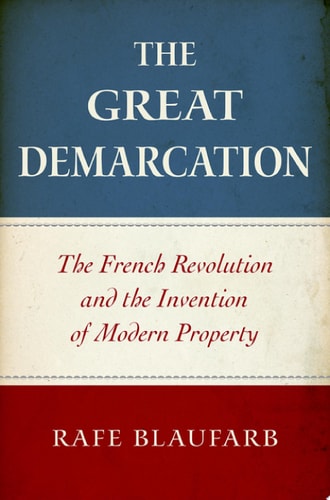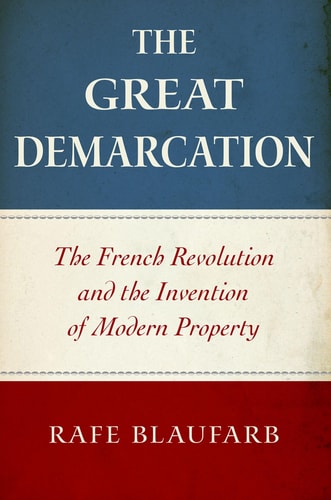
The Great Demarcation: The French Revolution and the Invention of Modern Property
0
0
As an Amazon Associate and affiliate partner, Menrva Books earns from qualifying purchases. Learn more
Author Description
What does it mean to own something? What sorts of things can be owned, and what cannot? How does one relinquish ownership? What are the boundaries between private and public property? Over the course of a decade, the French Revolution grappled with these questions. Punctuated by false starts, contingencies, and unexpected results, this process laid the foundations of the Napoleonic Code and modern notions of property.As Rafe Blaufarb demonstrates in this ambitious work, the French Revolution remade the system of property-holding that had existed in France before 1789. The revolutionary changes aimed at two fundamental goals: the removal of formal public power from the sphere of property and the excision of property from the realm of sovereignty. The revolutionaries accomplished these two aims by abolishing privately-owned forms of power, such as jurisdictional lordship and venal public office, and by dismantling the Crown domain, thus making the state purely sovereign. This brought about a Great Demarcation: a radical distinction between property and power from which flowed the critical distinctions between the political and the social, state and society, sovereignty and ownership, the public and private. It destroyed the conceptual basis of the Old Regime, laid the foundation of France's new constitutional order, and crystallized modern ways of thinking about polities and societies.By tracing how the French Revolution created a new legal and institutional reality, The Great Demarcation shows how the revolutionary transformation of Old Regime property helped inaugurate political modernity
Menrva's Summary
THE THESIS
This work investigates how the French Revolution fundamentally redefined the concepts of ownership and sovereignty to establish the framework of modern property law. Rafe Blaufarb, a historian specializing in the French Revolution, utilizes extensive legal and institutional records to argue that the revolutionary era enacted a 'Great Demarcation.' By separating private property from public power, the revolutionaries dismantled the Old Regime's jurisdictional lordship and venal offices, thereby creating the modern distinction between state and society.
THE SCOPE MAP
What You Will Find
- Analysis of the transition from feudal property systems to the Napoleonic Code.
- Examination of the abolition of jurisdictional lordship and venal public office.
- Investigation into the dismantling of the Crown domain.
Scope Limits
- The study focuses primarily on the legal and institutional transformations within France rather than the broader socio-economic impacts on the peasantry or global colonial property regimes.
THE AUTHORITY PERSPECTIVE
Scholars and historians recognize this text as a significant contribution to the understanding of political modernity and the evolution of legal structures. Readers frequently note the academic density of the prose, which is tailored for those interested in the intersection of legal theory and revolutionary history.
Page Count:
304
Publication Date:
2019-04-01
Publisher:
Oxford University Press
ISBN-10:
0190056525
ISBN-13:
9780190056520
Politics
History
World politics
European History
Property Law
New Used & Rental Textbooks
French Revolution
Europe
France
Military
Administrative Law
Property
Politics & Government
Legal History
World
Law