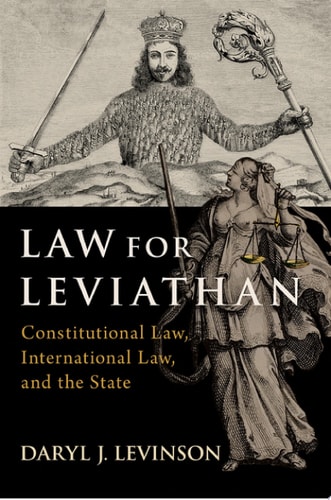
Law for Leviathan: Constitutional Law, International Law, and the State
0
0
As an Amazon Associate and affiliate partner, Menrva Books earns from qualifying purchases. Learn more
Author Description
For the past several centuries of Anglo-American legal thought, law has been paradigmatically understood as the product of the state. The state, operating through the legal and political institutions of its government, imposes law on the people who are its subjects. Over the same centuries, however, the development of international law and constitutional law has made the state itself subject to law. These systems of law for states necessarily work differently. For one thing, law for states must do without a super-state or government standing above the state, capable of creating and enforcing law. For another, the state is a unique kind of legal subject, calling for different behavioral models, moral standards, and regulatory techniques than those developed for ordinary people. It is precisely these differences that have long marked international law as a curious, and in many eyes dubious, form of law.Constitutional law, in contrast, has seldom been subject to the same doubts, or fully understood as different in kind from legal systems run by and through the state. As a result, constitutionalists have lagged their internationalist counterparts in coming to grips with the common project of making the state the subject rather than the source of law. By assimilating constitutional and international law as parallel projects of imposing law upon the state, and by highlighting the peculiarities of the state as a subject of law, this book aspires to close that gap, and to bring focus to Law for Leviathan as a distinctive legal form.
Menrva's Summary
THE THESIS
How can the state be effectively governed by law when it is simultaneously the primary source of legal authority? Daryl J. Levinson, a scholar of constitutional law and political theory, examines the structural parallels between constitutional and international law. He argues that both fields share the project of subjecting the state to legal constraints, despite the absence of a higher sovereign authority to enforce these rules.
THE SCOPE MAP
What You Will Find
- Comparative analysis of constitutional and international legal frameworks.
- Theoretical models for regulating state behavior without a super-state entity.
- Examination of the state as a unique legal subject distinct from individual citizens.
Scope Limits
- The text does not provide a practical handbook for litigation or specific policy drafting.
- It does not cover the historical evolution of individual human rights law outside the context of state regulation.
THE AUTHORITY PERSPECTIVE
Legal scholars identify this work as a significant contribution to the field of jurisprudence by bridging the gap between constitutional and international legal theory. Readers frequently note the high level of academic density and the rigorous analytical framework applied to the concept of the state.
Page Count:
312
Publication Date:
2024-01-01
Publisher:
Oxford University Press
ISBN-10:
0190061596
ISBN-13:
9780190061593
Self-help
General
Relationships
Legal Theory
Schools & Teaching
Constitutional Law
Law
Jurisprudence
Administrative Law
Public
International Law
Education Teaching
Community Tags
Similar Books