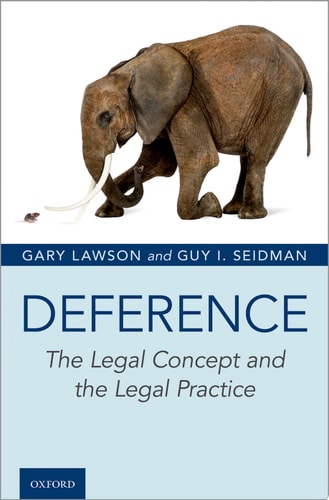
Deference: The Legal Concept and the Legal Practice
0
0
As an Amazon Associate and affiliate partner, Menrva Books earns from qualifying purchases. Learn more
Author Description
Deference is perhaps the most important concept and practice in law. It lies at the core of every system of precedent, appellate review, federalism, and separation of powers, all of which center on how one actor should deal with previous decisions. Oddly enough, deference is also one of the most under-analyzed and under-theorized legal concepts and practices, perhaps because its applications are so varied. This book's goal is to provide a definition of deference and a vocabulary for discussing it that can be used to describe, explain, and/or criticize deference in all of its manifestations, including some manifestations that are not always identified by legal actors as instances of deference. This project does not seek to prescribe whether and how any legal system should apply deference in any specific circumstance or to critique any particular deference doctrines. Rather, it aims to bring the concept of deference to the forefront of legal discussion; to identify, catalogue, and analyze at least the chief among its many applications; to set forth the many and varied rationales that can be and have been offered in support of deference in different legal contexts; and thereby to provide a vocabulary and conceptual framework that can be employed in future projects, whether those projects are descriptive or prescriptive.
Menrva's Summary
THE THESIS
This book investigates the fundamental nature of deference as a central, yet under-theorized, concept and practice within legal systems. Authors Gary Lawson and Guy I. Seidman, both established legal scholars, utilize a broad survey of legal doctrines to construct a comprehensive vocabulary for identifying and analyzing deference. Their primary argument posits that by categorizing the varied manifestations of deference, legal actors can better describe, explain, and critique its application across diverse contexts such as appellate review and separation of powers.
THE SCOPE MAP
What You Will Find
- A conceptual framework for defining deference across multiple legal domains.
- An identification and cataloging of primary deference applications in law.
- An analysis of the diverse rationales supporting deference in different contexts.
Scope Limits
- The text does not provide prescriptive guidance on how legal systems should apply deference.
- The authors do not offer specific critiques of individual existing deference doctrines.
THE AUTHORITY PERSPECTIVE
Legal scholars view this work as a foundational effort to bring analytical rigor to a previously under-theorized area of jurisprudence. Experts highlight the text as a necessary resource for those seeking to standardize the vocabulary used in discussions regarding appellate review and institutional authority.
Page Count:
228
Publication Date:
2019-12-09
Publisher:
Oxford University Press
ISBN-10:
0190273402
ISBN-13:
9780190273408
Constitutional Law
United States
Administrative Law
Law
Legal Theory
Jurisprudence
Professional Career & Trade
Community Tags
Similar Books