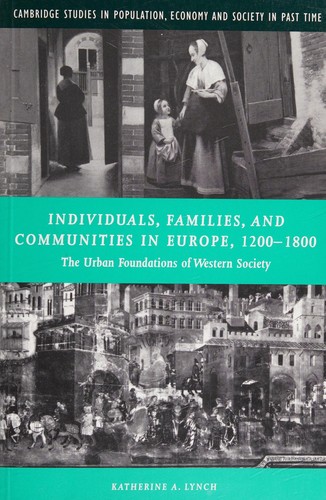
Individuals, Families and Communities in Europe, 1200-1800: The Urban Foundations of Western Society
0
0
As an Amazon Associate and affiliate partner, Menrva Books earns from qualifying purchases. Learn more
Author Description
Katherine Lynch discusses the role of the family in society from the late Middle Ages to the industrial period. She argues that in western Europe an ongoing, and recognizably western pattern of relationships among individuals, their families, and communities emerged in the late medieval period. Tracing the pattern through the nineteenth century, this study explores the family's function as an organization on the boundary between public and private life, rather than as part of a "private sphere", and how this phenomenon has been influenced by political, religious and demographic factors.
Menrva's Summary
THE THESIS
This book investigates the foundational role of urban environments in shaping the relationships between individuals, families, and communities in Western Europe from 1200 to 1800. Katherine Lynch, drawing on extensive historical research, posits that a distinct Western European pattern of social organization emerged in urban centers during the late Middle Ages. The study examines how the family functioned as a crucial interface between public and private life, influenced by evolving political, religious, and demographic landscapes throughout this period.
THE SCOPE MAP
- Analysis of the family's role in society from the late Middle Ages to the industrial period.
- Argument for the emergence of a recognizably Western pattern of relationships in urban settings.
- Exploration of the family's function as an organization on the boundary between public and private life.
- Examination of the influence of political factors on family and community structures.
- Assessment of the impact of religious developments on social relationships.
- Discussion of demographic shifts and their effect on family and community dynamics.
- Focus on the urban foundations of Western society during the specified historical period.
THE AUTHORITY PERSPECTIVE
The book is recognized for its detailed examination of the evolving role of the family within urban contexts across several centuries of European history. It presents a clear argument regarding the formation of distinct Western social patterns, emphasizing the family's position as a mediator between public and private spheres. The analysis is noted for its consideration of the interplay between social structures and broader political, religious, and demographic forces.
Page Count:
250
Publication Date:
2003-01-01
ISBN-10:
0521645417
Non-Fiction
History
Family history
Sociology
European History
Urban History
Social History
Community Tags
Similar Books