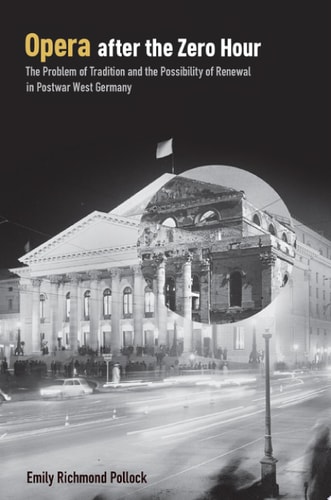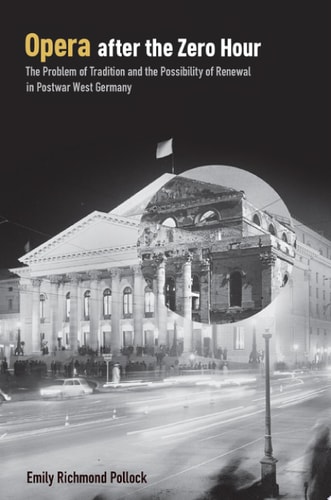
Opera After the Zero Hour: The Problem of Tradition and the Possibility of Renewal in Postwar West Germany
0
0
As an Amazon Associate and affiliate partner, Menrva Books earns from qualifying purchases. Learn more
Author Description
Opera After The Zero Hour: The Problem Of Tradition And The Possibility Of Renewal In Postwar West Germany Presents Opera As A Site For The Renegotiation Of Tradition In A Politically Fraught Era Of Rebuilding. Though The Zero Hour Put A Rhetorical Caesura Between National Socialism And Postwar West Germany, The Postwar Era Was Characterized By Significant Cultural Continuity With The Past. With Nearly All Of The Major Opera Houses Destroyed And A Complex Relationship To The Competing Ethics Of Modernism And Restoration, Opera Was A Richly Contested Art Form, And The Genre's Reputed Conservatism Was Remarkably Multi-faceted. Author Emily Richmond Pollock Explores How Composers Developed Different Strategies To Make New Opera New While Still Deferring To Historical Conventions, All Of Which Carried Cultural Resonances Of Their Own. Diverse Approaches To Operatic Tradition Are Exemplified Through Five Case Studies In Works By Boris Blacher, Hans Werner Henze, Carl Orff, Bernd Alois Zimmermann, And Werner Egk. Each Opera Alludes To A Distinct Cultural Or Musical Past, From Greek Tragedy To Dada, Bel Canto To Berg. Pollock's Discussions Of These Pieces Draw On Source Studies, Close Readings, Unpublished Correspondence, Institutional History, And Critical Commentary To Illuminate The Politicized Artistic Environment That Influenced These Operas' Creation And Reception. The Result Is New Insight Into How The Particular Opposition Between A Conservative Genre And The Idea Of The Zero Hour Motivated The Development Of Opera's Social, Aesthetic, And Political Value After World War Ii.
Menrva's Summary
THE THESIS
This book investigates how opera functioned as a critical site for the renegotiation of cultural tradition within the politically fraught environment of postwar West Germany. Emily Richmond Pollock, a musicologist, examines the tension between the rhetorical 'Zero Hour'—which sought a clean break from the Nazi past—and the reality of deep cultural continuity. By analyzing the work of five prominent composers, she argues that opera served as a complex medium where aesthetic innovation and historical deference were used to reconstruct national identity.
THE SCOPE MAP
What You Will Find
- Analysis of operatic works by Boris Blacher, Hans Werner Henze, Carl Orff, Bernd Alois Zimmermann, and Werner Egk.
- Examination of the intersection between institutional history and artistic creation in the aftermath of World War II.
- Integration of primary source materials including unpublished correspondence, critical commentary, and archival records.
Scope Limits
- The study focuses specifically on West Germany and does not provide an exhaustive survey of East German operatic developments.
- The analysis is limited to the immediate postwar period and does not extend into late 20th-century operatic trends.
THE AUTHORITY PERSPECTIVE
Scholars and music historians recognize this work as a significant contribution to the study of postwar German cultural politics. Readers frequently note the academic density of the prose, which provides a rigorous examination of how musical tradition was repurposed in a divided and rebuilding nation.
Page Count:
304
Publication Date:
2019-01-01
Publisher:
Oxford University Press
ISBN-10:
0190063750
ISBN-13:
9780190063757
Musicology
Music History
German history
Opera