Language output, communication strategies and communicative tasks
0
0
As an Amazon Associate and affiliate partner, Menrva Books earns from qualifying purchases. Learn more
Author Description
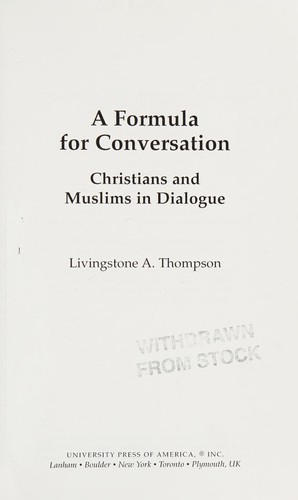
Beginning with the presupposition that Christians and Muslims will forever be living side-by-side, this work is an attempt to face squarely the question of what Christians can truly say about Islam. Recognizing the differences in doctrinal emphases in Christianity, a critical methodology is that the argument is developed from the point of view of a particular Christian communion, so as to give concreteness to the argument. Such a communion has to be carefully chosen in order to find acceptability across the whole spectrum of the Christian faith. To a large extent the relationship between Christians and Muslims is characterized by mutual ignorance of those things that are essential to their faiths. That ignorance is also reinforced by media depictions of half-truths or untruths. A Formula for Conversation looks at the doctrines that both communities consider non-negotiable. It is the possibility of being able to say something of Islam that the Muslim would be happy to accept and that Christians can identify with that creates a moment for dialogue. (Back cover).
Menrva's Summary
THE THESIS
This work seeks to establish a foundation for constructive dialogue between Christians and Muslims by examining their core, non-negotiable doctrines. The author, Cynthia F. K. Lee, approaches this complex topic from a specific Christian communion's perspective to provide concrete arguments, aiming for broad Christian acceptability. The book addresses the mutual ignorance and misinformation that often characterize Christian-Muslim relations, proposing that finding common ground on essential tenets can create opportunities for genuine conversation. It focuses on identifying points of Islamic doctrine that Muslims would accept and Christians can identify with, thereby fostering understanding.
THE SCOPE MAP
- Exploration of core Christian doctrines and their relationship to Islamic beliefs.
- Analysis of non-negotiable tenets within both Christianity and Islam.
- Methodology developed from the viewpoint of a specific Christian communion.
- Strategies for identifying common ground for interfaith dialogue.
- Examination of mutual ignorance and media misrepresentations between the faiths.
- Focus on creating moments for conversation and understanding.
THE AUTHORITY PERSPECTIVE
The book is framed as an attempt to bridge the gap of mutual ignorance between Christians and Muslims, focusing on identifying non-negotiable doctrines that can serve as a basis for dialogue. The author's chosen methodology, presenting arguments from a specific Christian communion's perspective, aims to provide concrete examples while seeking broad acceptability across Christian denominations. The work directly confronts the challenges posed by misinformation and mutual misunderstanding, suggesting that a careful articulation of shared or relatable tenets can foster constructive interfaith engagement.
Page Count:
154
Publication Date:
2005-01-01
ISBN-10:
0761828869
Action
Religion
Non-Fiction
Islam
Christianity
Interfaith Dialogue
Community Tags
Similar Books