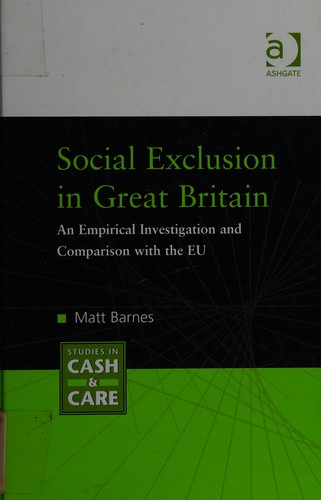
Social Exclusion in Great Britain: An Empirical Investigation and Comparison with the EU
0
0
As an Amazon Associate and affiliate partner, Menrva Books earns from qualifying purchases. Learn more
Author Description
In Great Britain, the reduction of social exclusion has been at the forefront of New Labour's social policy since 1997. However, there is ambiguity about what the notion of social exclusion actually encompasses, caused in part by the limited extent of attempts to measure and understand social exclusion empirically. This key work addresses this problem, employing data from a nationally representative survey of British households to quantify levels of social exclusion and the composition of the socially excluded population. It also incorporates data from a European Commission-funded household survey to compare social exclusion in Great Britain with eleven other countries in the European Union. In the book, Matt Barnes argues that social exclusion refers to enduring disadvantage on a wide range of living standards, not just those that reflect economic values. As well as looking at standard measures of poverty he looks at more relational measures of disadvantage such as neighbourhood discontent and social isolation, in order to determine exclusion from the economic, social and cultural systems that determine the integration of a person in society.--Jacket.
Menrva's Summary
THE THESIS
This book investigates the empirical measurement and comparative analysis of social exclusion in Great Britain and the European Union. The work addresses the ambiguity surrounding the concept of social exclusion by quantifying its levels and identifying the characteristics of the socially excluded population using data from a nationally representative survey of British households. It further compares these findings with eleven other European Union countries through a European Commission-funded household survey. The author posits that social exclusion encompasses enduring disadvantage across a broad spectrum of living standards, extending beyond purely economic measures to include relational aspects like neighborhood discontent and social isolation.
THE SCOPE MAP
- Quantification of social exclusion levels in Great Britain.
- Identification of the composition of the socially excluded population.
- Comparative analysis of social exclusion across eleven EU countries.
- Examination of social exclusion beyond standard poverty measures.
- Inclusion of relational measures of disadvantage, such as neighborhood discontent and social isolation.
- Analysis of exclusion from economic, social, and cultural systems.
- Empirical investigation using data from a nationally representative British household survey.
- Utilization of data from a European Commission-funded household survey for cross-national comparison.
THE AUTHORITY PERSPECTIVE
The book provides a key empirical investigation into social exclusion, a topic central to New Labour's social policy. By employing extensive survey data, it offers a quantified understanding of exclusion and its multifaceted nature, moving beyond purely economic indicators. The comparative element with other EU nations adds significant value, situating the British experience within a broader European context. The work is positioned as a foundational text for understanding and measuring social exclusion.
Page Count:
230
Publication Date:
2005-01-01
ISBN-10:
0754642097
Economics
Non-Fiction
Politics
Social policy
Sociology
Community Tags
Similar Books