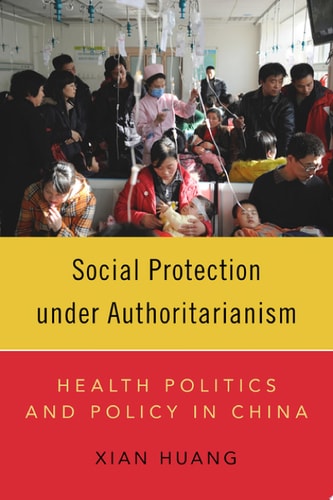
Social Protection under Authoritarianism: Health Politics and Policy in China
0
0
As an Amazon Associate and affiliate partner, Menrva Books earns from qualifying purchases. Learn more
Author Description
Why would an authoritarian regime expand social welfare provision in the absence of democratization? Yet China, the world's largest and most powerful authoritarian state, has expanded its social health insurance system at an unprecedented rate, increasing enrollment from 20 percent of its population in 2000 to 95 percent in 2012. Significantly, people who were uninsured, such as peasants and the urban poor, are now covered, but their insurance is less comprehensive than that of China's elite. With the wellbeing of 1.4 billion people and the stability of the regime at stake, social health insurance is now a major political issue for Chinese leadership and ordinary citizens.In Social Protection under Authoritarianism, Xian Huang analyzes the transformation of China's social health insurance in the first decade of the 2000s, addressing its expansion and how it is distributed. Drawing from government documents, filed interviews, survey data, and government statistics, she reveals that Chinese leaders have a strategy of "stratified expansion," perpetuating a particularly privileged program for the elites while developing an essentially modest health provision for the masses. She contends that this strategy effectively balances between elites and masses to maximize the regime's prospects of stability.In China's multilevel governance, both centralized and decentralized structures are involved in the distribution of social health insurance. When local leaders implement the stratified expansion of social health insurance, they respond to varied local conditions. As a result, China's health insurance policies differ dramatically across subnational regions as well as socioeconomic groups. Providing an in-depth look into China's health insurance system, this book sheds light not only on Chinese politics, but also on how social benefits function in authoritarian regimes and decentralized multilevel governance settings.
Menrva's Summary
THE THESIS
This book investigates why an authoritarian regime would expand social welfare provision in the absence of democratization, specifically focusing on the rapid growth of China's health insurance system. Xian Huang, a scholar of Chinese politics, utilizes a framework of "stratified expansion" to explain how the state balances the needs of the elite against the masses. By analyzing government documents, survey data, and field interviews, she argues that this policy serves as a strategic mechanism to maintain regime stability while perpetuating socioeconomic inequality.
THE SCOPE MAP
What You Will Find
- Analysis of the expansion of China's social health insurance from 2000 to 2012.
- Examination of multilevel governance and its impact on policy implementation.
- Comparative study of health insurance distribution across different socioeconomic groups and subnational regions.
Scope Limits
- The analysis is primarily focused on the first decade of the 2000s.
- The study does not provide a comprehensive history of Chinese healthcare prior to the 2000s.
THE AUTHORITY PERSPECTIVE
Experts identify this work as a significant contribution to the study of authoritarian resilience and social policy in contemporary China. Readers frequently note the clarity with which the author connects complex multilevel governance structures to tangible health outcomes for the Chinese population.
Page Count:
280
Publication Date:
2020-08-31
Publisher:
Oxford University Press
ISBN-10:
0190073640
ISBN-13:
9780190073640
Politics
Authoritarianism
Public Policy
New Used & Rental Textbooks
Law
Health insurance
Politics & Government
Cultural
Health Policy
Systems Theory
Social policy
Medical policy
Anthropology
Social Welfare
Healthcare Policy
China Studies
Welfare state
Comparative Politics
Community Tags
Similar Books