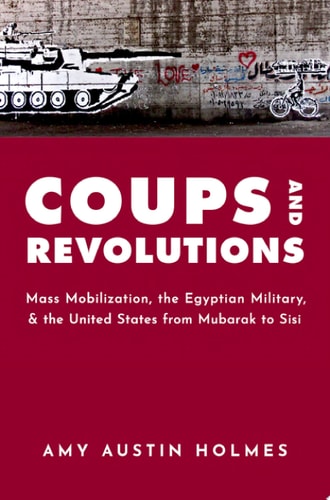
Coups and Revolutions
0
0
As an Amazon Associate and affiliate partner, Menrva Books earns from qualifying purchases. Learn more
Author Description
In 2011, Egypt Witnessed More Protests Than Any Other Country In The World. Counter To The Received Narrative, Amy Austin Holmes Argues That The Ousting Of Mubarak In 2011 Did Not Represent The Culmination Of A Revolution Or The Beginning Of A Transition Period, But Rather The Beginning Of A Revolutionary Process That Would Unfold In Three Waves, Followed By Two Waves Of Counterrevolution. This Book Offers The First Analysis Of Both The Revolution And Counterrevolution In Egypt From January 2011 Until June 2018. The Period Of Revolutionary Upheaval Played Out In Three Uprisings Against Three Distinct Forms Of Authoritarian Rule: The Mubarak Regime And The Police State That Protected It, The Unelected Military Junta Known As The Supreme Council Of Armed Forces, And The Religious Authoritarianism Of The Muslim Brotherhood. The Counterrevolution Occurred Over Two Periods: The First Under Adly Mansour As Interim President And The Second After El Sisi Was Elected President. While The Regime Imprisoned Or Killed The Leadership Of The Muslim Brotherhood And Many Secular Activists During The First Wave Of The Counterrevolution, It Turned Against Civil Society At Large During The Second: Ngos, Charities, Media, Academia, And Minority Groups. In Addition To Providing New And Unprecedented Empirical Data, Coups And Revolutions Makes Two Theoretical Contributions. First, It Presents A New Framework For Analyzing The State Apparatus In Egypt Based On Four Pillars Of Regime Support That Can Either Prop Up Or Press Upon Whoever Is In Power. These Are The Egyptian Military, The Business Elite, The United States, And The Multi-headed Opposition. Secondly, The Book Brings Together The Literature On Bottom-up Revolutionary Movements And Top-down Military Coups, And It Introduces The Concept Of A Coup From Below In Contrast To The Revolution From Above That Took Place Under Gamal Abdel Nasser.
Menrva's Summary
THE THESIS
This book investigates the complex political trajectory of Egypt between 2011 and 2018 to determine whether the events constituted a singular revolution or a prolonged, multi-stage revolutionary process. Amy Austin Holmes, a scholar specializing in Middle Eastern politics, utilizes extensive empirical data to challenge the conventional narrative of a simple transition. She proposes a new analytical framework centered on four pillars of regime support—the military, business elite, the United States, and the opposition—to explain how power dynamics shifted across three distinct uprisings and two waves of counterrevolution.
THE SCOPE MAP
What You Will Find
- A detailed analysis of Egyptian political shifts from January 2011 to June 2018.
- A theoretical framework identifying the four pillars of regime support.
- The introduction of the concept of a 'coup from below' as a mechanism for regime change.
Scope Limits
- The analysis focuses primarily on the Egyptian state apparatus and does not provide an exhaustive history of the region beyond the specified timeframe.
- The study does not cover political developments in Egypt occurring after the mid-2018 cutoff point.
THE AUTHORITY PERSPECTIVE
Experts recognize this work as a significant contribution to the study of authoritarianism and civil-military relations in the Middle East. Readers frequently note the academic rigor and the clarity of the author's theoretical framework in navigating a highly volatile political period.
Page Count:
288
Publication Date:
2019-01-01
Publisher:
Oxford University Press
ISBN-10:
019007146X
ISBN-13:
9780190071462
History
Egypt
Political Activity
Middle Eastern
International relations
Revolution
Community Tags
Similar Books