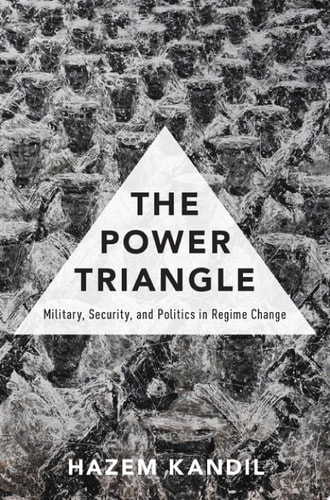
The Power Triangle: Military, Security, and Politics in Regime Change
0
0
As an Amazon Associate and affiliate partner, Menrva Books earns from qualifying purchases. Learn more
Author Description
Revolution, reform, and resilience comprise the respective fortunes of modern Iran, Turkey, and Egypt. Although the countries all experienced coups with remarkably similar ambitions, each followed a very different trajectory. Iran became an absolutist monarchy that was overthrown from below, Turkey evolved into a limited democracy, and Egypt turned into a police state.In The Power Triangle, Hazem Kandil attributes the different outcomes to the power struggle between the political, military, and security institutions. Coups establish a division of labor, with one group of officers running government, another overseeing the military, and a third handling security. But their interests begin to vary as each group identifies with its own institution. Politicians wish to rule indefinitely; military officers prefer to return to barracks after implementing the needed reforms; and security men scramble to maintain the privileges they acquired in the post-coup emergency. Driven by conflicting agendas, these partners in domination struggle over regime control. Using comparative historical sociology, Kandil demonstrates how regimes are constantly shaped and reshaped through the recurrent clashes and shifting alliances between the team of rivals in this "power triangle."The Power Triangle's realist approach to regime change shows that a clear explanation of pivotal events in Iran, Turkey, and Egypt is impossible without a firm grasp of the power relations within each country's ruling bloc.
Menrva's Summary
THE THESIS
How do the divergent power struggles between military, security, and political institutions determine the long-term trajectory of regimes following a coup? Hazem Kandil, a scholar of political sociology, utilizes a comparative historical framework to analyze the post-coup developments in Iran, Turkey, and Egypt. He argues that the internal friction between these three institutional pillars—each with distinct organizational interests—dictates whether a state evolves into a democracy, an absolutist monarchy, or a police state.
THE SCOPE MAP
What You Will Find
- Comparative analysis of regime evolution in Iran, Turkey, and Egypt.
- A theoretical framework defining the institutional roles of military, security, and political actors.
- Historical examination of post-coup power dynamics and institutional competition.
Scope Limits
- The analysis does not focus on grassroots social movements or external geopolitical influences.
- The study is restricted to the specific institutional dynamics within the three named nations.
THE AUTHORITY PERSPECTIVE
Experts recognize this work as a significant contribution to the study of civil-military relations and authoritarianism in the Middle East. Readers frequently note the analytical clarity and the structured, realist approach the author applies to complex historical transitions.
Page Count:
424
Publication Date:
2016-09-15
Publisher:
Oxford University Press
ISBN-10:
0190239204
ISBN-13:
9780190239206
History
International relations
Egypt
Middle Eastern
Civil-military relations
Iran
Politics & Government
Sociology
Community Tags
Similar Books