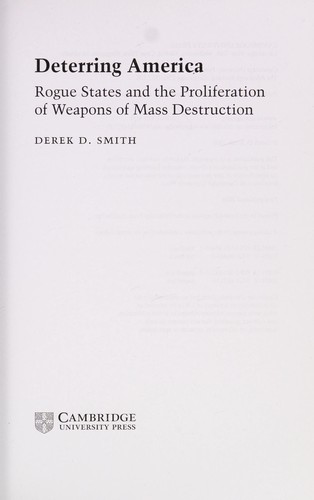
Deterring America: Rogue States and the Proliferation of Weapons of Mass Destruction
0
0
As an Amazon Associate and affiliate partner, Menrva Books earns from qualifying purchases. Learn more
Author Description
Faced with America's military superiority, many countries are turning to weapons of mass destruction (WMD) as a means to deter United States intervention. However, the events of September 11 awakened America to a degree of vulnerability it had never experienced before, making it increasingly unwilling to tolerate such weapons in the hands of unstable and unpredictable regimes. Through theoretical, historical, and prescriptive lenses, this book explores the modern security dilemma created by the twin fears of American encroachment and vulnerability which form a vicious cycle of insecurity that challenges traditional notions of deterrence. Using Iraq and North Korea as case studies, Smith argues that the United States may need to re-evaluate its foreign policy strategies against WMD proliferation, giving renewed attention to defensive measures, negotiated disarmament, interdiction, and perhaps preemption.--Publisher description.
Menrva's Summary
THE THESIS
This book investigates the complex security dilemma arising from the proliferation of weapons of mass destruction (WMD) in the face of American military dominance. It examines how nations, perceiving a threat from potential US intervention, turn to WMD for deterrence, a cycle exacerbated by post-9/11 American vulnerability and a resulting intolerance for unstable regimes possessing such weapons. The author, Derek V. Smith, utilizes theoretical, historical, and prescriptive approaches to analyze this escalating insecurity. The book posits that the United States must reconsider its strategies against WMD proliferation, exploring options beyond traditional deterrence.
THE SCOPE MAP
- Analysis of the modern security dilemma driven by WMD proliferation and perceived American encroachment.
- Exploration of the vicious cycle of insecurity between states seeking WMD and the US seeking to prevent it.
- Case studies of Iraq and North Korea to illustrate the dynamics of WMD proliferation and deterrence.
- Examination of theoretical frameworks related to deterrence and state behavior in the context of WMD.
- Prescriptive analysis of alternative US foreign policy strategies, including defensive measures, negotiated disarmament, interdiction, and preemption.
- Discussion of the implications of WMD proliferation for traditional notions of deterrence.
THE AUTHORITY PERSPECTIVE
The book analyzes the strategic implications of WMD proliferation, particularly in relation to American foreign policy and the concept of deterrence. It uses specific case studies to support its arguments regarding the cyclical nature of insecurity between states and the United States. The work suggests a need for re-evaluation of existing policies to address the evolving threat landscape. The author advocates for a broader range of strategies to counter WMD proliferation.
Page Count:
197
Publication Date:
2006-01-01
ISBN-10:
0521683130
ISBN-13:
9780521683135
Politics
Non-Fiction
History
Security Studies
Foreign Policy
International relations
Community Tags
Similar Books