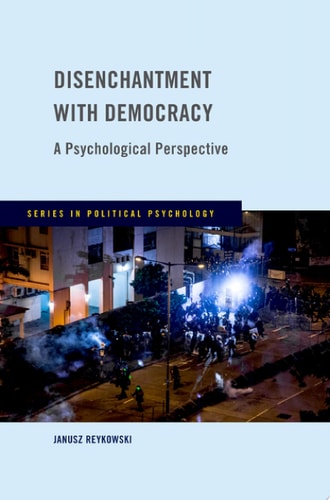
Disenchantment with Democracy: A Psychological Perspective
0
0
As an Amazon Associate and affiliate partner, Menrva Books earns from qualifying purchases. Learn more
Author Description
In recent years, there has been a rise in social movements and organizations that challenge the very foundations of liberal democracy on a global scale. Discrepancies of interests, ideological or worldview contradictions, and identity differences are more likely now to transform into destructive conflicts, and violence is used as a legitimate method for attaining political and economic goals. Drawing on the knowledge accumulated in social and political psychology, this book scrutinizes these phenomena and provides an even deeper understanding of the nature of these conflicts. The book also addresses the imperfections of liberal institutions, which can exacerbate these divides, providing crucial context for understanding contemporary political tensions and their effects on the world's democracies.
Menrva's Summary
THE THESIS
This book investigates the psychological drivers behind the global rise of social movements that challenge the foundational principles of liberal democracy. Author Janusz Reykowski utilizes established frameworks from social and political psychology to analyze how ideological contradictions and identity-based grievances escalate into systemic conflict. By examining the inherent limitations of liberal institutions, the text argues that current political instability is rooted in both individual psychological responses and structural institutional failures.
THE SCOPE MAP
What You Will Find
- Analysis of psychological mechanisms underlying political polarization
- Examination of how identity differences fuel destructive social conflicts
- Critique of liberal institutional structures that exacerbate societal divides
- Synthesis of contemporary global political trends through a psychological lens
Scope Limits
- Does not provide a comprehensive history of specific national political movements
- Does not offer a prescriptive policy manual for resolving all democratic tensions
THE AUTHORITY PERSPECTIVE
Experts recognize this work as a significant contribution to the Series in Political Psychology, noting its ability to bridge the gap between abstract psychological theory and concrete political reality. Readers frequently highlight the academic density of the prose, which is well-suited for scholars and students seeking a rigorous analysis of modern democratic fragility.
Page Count:
276
Publication Date:
2020-03-27
Publisher:
Oxford University Press
ISBN-10:
0190078588
ISBN-13:
9780190078584
Politics
Medical Books
Conflict Resolution
Counseling Psychology
Sociology
New Used & Rental Textbooks
Democracy
Political Psychology
Psychology
Politics & Government
Community Tags
Other Editions(2)
Similar Books