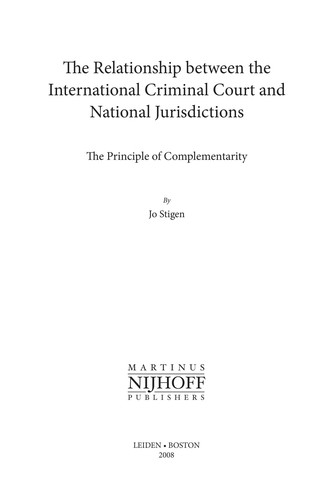
The Relationship Between the International Criminal Court and National Jurisdictions
0
0
As an Amazon Associate and affiliate partner, Menrva Books earns from qualifying purchases. Learn more
Author Description
This book seeks to answer these and other related questions by interpreting the relevant provisions of the Rome Statute and discussing them in a broad context. The book also critically assesses policy considerations underlying the establishment of the ICC, including the implications of international criminal justice for achieving peace. It asks, inter alia, whether the ICC should set aside an amnesty which a national truth commission has granted in an attempt to achieve a peaceful transition from tyranny to democracy.--Jacket.
Menrva's Summary
THE THESIS
This book investigates the complex interplay between the International Criminal Court (ICC) and national legal systems. It critically examines the policy considerations behind the ICC's creation, particularly its role in achieving peace and reconciliation. The author analyzes the implications of international criminal justice for transitions from authoritarian rule, posing questions about the ICC's stance on national amnesties granted by truth commissions.
THE SCOPE MAP
- Analysis of the Rome Statute's provisions concerning the relationship between the ICC and national jurisdictions.
- Discussion of policy considerations underlying the establishment of the ICC.
- Assessment of the implications of international criminal justice for achieving peace.
- Examination of the ICC's potential role in relation to national truth commissions and amnesties.
- Exploration of the challenges in balancing international accountability with national reconciliation processes.
THE AUTHORITY PERSPECTIVE
The book is recognized for its in-depth analysis of the International Criminal Court's jurisdictional challenges and its relationship with national legal frameworks. It is noted for its critical engagement with the policy considerations that shaped the ICC, particularly concerning its potential contribution to peace and reconciliation. The work is considered a valuable resource for understanding the delicate balance between international justice and national transitional processes, especially when dealing with amnesties granted by truth commissions.
Page Count:
533
Publication Date:
2008-01-01
ISBN-10:
9004169091
ISBN-13:
9789004169098
History
Crime
Non-Fiction
Politics
Justice
Law
International relations
Community Tags
Similar Books