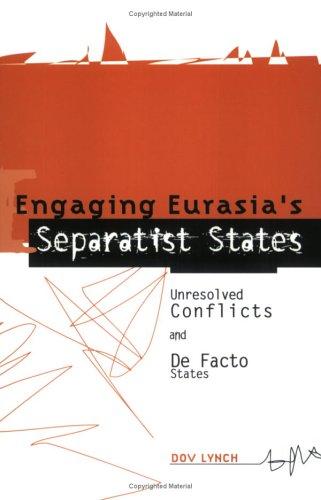
Engaging Eurasia's Separatist States
0
0
As an Amazon Associate and affiliate partner, Menrva Books earns from qualifying purchases. Learn more
Author Description
In the wake of the dissolution of the Soviet Union, secessionist forces carved four de facto states from parts of Moldova, Georgia, and Azerbaijan. Ten years on, those states are mired in uncertainty. Beset by internal problems, fearful of a return to the violence that spawned them, and isolated and unrecognized internationally, they survive behind cease-fire lines that have temporarily frozen but not resolved their conflicts with the metropolitan powers. In this, the first in-depth comparative analysis of these self-proclaimed republics, Dov Lynch examines the logic that maintains this uneasy existence and explores ways out of their volatile predicament. Drawing on extensive travel within Eurasia and remarkable access to leading figures in the secessionist struggles, Lynch spotlights the political, military, and economic dynamics - both internal and external - that drive the existence of South Ossetia, Abkhazia, Transnistria, and Nagorno-Karabakh. He also evaluates a range of options for resolving the status of the de facto states before violence returns, and proposes a coordinated approach, spearheaded by the European Union, that balances de facto and de jure independence and sovereignty.
Menrva's Summary
THE THESIS
This book investigates the precarious existence of four de facto states that emerged in Eurasia following the Soviet Union's dissolution. Ten years after their formation, these self-proclaimed republics—South Ossetia, Abkhazia, Transnistria, and Nagorno-Karabakh—face internal instability, international isolation, and the lingering threat of renewed conflict with their metropolitan powers. Dov Lynch, drawing on extensive travel and access to key figures, analyzes the political, military, and economic forces sustaining these entities and explores potential pathways toward resolution.
THE SCOPE MAP
- What You Will Find:
- Comparative analysis of South Ossetia, Abkhazia, Transnistria, and Nagorno-Karabakh.
- Examination of the internal political, military, and economic dynamics of the de facto states.
- Analysis of the external relations and international non-recognition faced by these republics.
- Evaluation of various options for resolving the status of the de facto states.
- Proposal for a coordinated approach, led by the European Union, to balance de facto and de jure independence.
THE AUTHORITY PERSPECTIVE
The book offers a timely and in-depth comparative analysis of post-Soviet separatist states, a region often characterized by frozen conflicts and international ambiguity. Lynch's extensive fieldwork and access to prominent figures provide a unique perspective on the internal and external factors sustaining these entities. The work is noted for its detailed examination of the political, military, and economic landscapes within South Ossetia, Abkhazia, Transnistria, and Nagorno-Karabakh. It also proposes concrete strategies for conflict resolution, advocating for a European Union-led initiative to address the complex issue of de facto versus de jure sovereignty.
Page Count:
170
Publication Date:
2004-01-01
ISBN-10:
1929223544
Politics
Non-Fiction
History
International relations
Conflict Resolution
Geopolitics
Community Tags
Similar Books