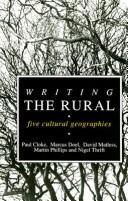
Writing the Rural
0
0
As an Amazon Associate and affiliate partner, Menrva Books earns from qualifying purchases. Learn more
Author Description
This book arises out of an ESRC project devoted to an examination of the economic, social and cultural impacts of the 'service class' on rural areas. The research was an attempt to document these impacts through close empirical work in a set of three rural communities, but something happened on the way. The authors found that the 'rural' became a real sticking point. Respondents used it in different ways - as a bludgeon, as a badge, as a barometer - to signify many different things - security, identity, community, domesticity, gender, sexuality, ethnicity - nearly always by drawing on many different sources - the media, the landscape, friends and kin, animals. It became abundantly clear that the 'rural', whatever chameleon form it took, was a prime and deeply-felt determinant of the actions of many respondents. Yet it was also clear to the authors that they possessed no theoretical framework that could allow them to negotiate the 'rural' to deconstruct its diverse nature as a category. Rather, each of the extended essays in the book is an attempt by each author to draw out one aspect of the rural by drawing on different traditions in social and cultural theory. The essays are not just attempts to re-describe the changing rural scene; they are also attempts to understand changes as part of a wider cultural problem: the location of the 'rural' as the subject and object of new meanings, conventions and strategies of dissemination. As essays they are not exhaustive but they do begin to address these new kinds of rural geographies.
Menrva's Summary
THE THESIS
THE THESIS
This book investigates the multifaceted and contested meanings of 'the rural' within contemporary society, particularly as they are shaped by the impacts of the 'service class'. The research, initially an ESRC project examining economic, social, and cultural effects in three rural communities, evolved to explore how the concept of 'the rural' itself functions as a significant determinant of individual actions and identities. The authors found that respondents utilized 'the rural' in diverse ways—as a symbol of security, identity, community, domesticity, gender, sexuality, and ethnicity—often drawing from various sources like media, personal relationships, and cultural narratives.
THE SCOPE MAP
- What You Will Find:
- An examination of the economic, social, and cultural impacts of the 'service class' on rural areas.
- Empirical case studies from three distinct rural communities.
- Analysis of how 'the rural' is used by respondents as a signifier for identity, security, and community.
- Exploration of diverse theoretical frameworks from social and cultural theory to deconstruct the concept of 'the rural'.
- Discussion of the 'rural' as both subject and object of new meanings and strategies of dissemination.
- An address of new kinds of rural geographies and their implications.
THE AUTHORITY PERSPECTIVE
THE AUTHORITY PERSPECTIVE
This collection of essays likely offers a nuanced and theoretically informed perspective on the evolving nature of rural identity and experience. By drawing on diverse social and cultural theories, the authors aim to deconstruct the complex meanings attributed to 'the rural'. The work appears to be a scholarly contribution to understanding contemporary rural geographies and the social dynamics at play within these communities.
Page Count:
258
Publication Date:
1994-01-01
ISBN-10:
1853961973
Philosophy
Non-Fiction
Sociology
Rural Studies
Social Theory
Community Tags
Similar Books