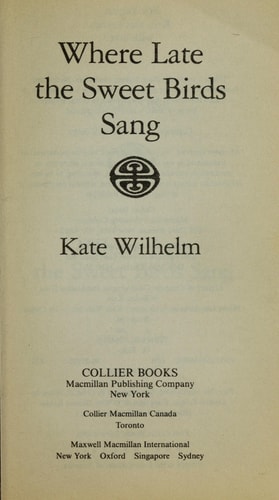
Where Late the Sweet Birds Sang
0
0
As an Amazon Associate and affiliate partner, Menrva Books earns from qualifying purchases. Learn more
Author Description
When the first warm breeze of Doomsday came wafting over the Shenandoah Valley, the Sumners were ready. Using their enormous wealth, the family had forged an isolated post-holocaust citadel. Their descendants would have everything they needed to raise food and do the scientific research necessary for survival. But the family was soon plagued by sterility, and the creation of clones offered the only answer. And that final pocket of human civilization lost the very human spirit it was meant to preserve as man and mannequin turned on one another. Sweeping, dramatic, rich with humanity, and rigorous in its science, Where Late the Sweet Birds Sang is widely regarded as a high point of both humanistic and hard science fiction. It won science fiction's Hugo Award and Locus Award on its first publication and is as compelling today as it was then.
Menrva's Summary
THE PULSE
As global civilization collapses, the wealthy Sumner family retreats to a fortified valley to ensure the survival of their lineage through advanced cloning technology. The narrative follows multiple generations of the Sumner clan as they navigate the physical isolation of their sanctuary and the logical consequences of their reliance on genetic replication. Faced with the biological reality of widespread sterility, the family shifts from traditional reproduction to cloning, a decision that fundamentally alters their social structure and individual identities. The story unfolds through a multi-generational perspective, examining the slow erosion of human individuality within a closed, controlled environment.
INSIDE THE PAGES
- Multi-generational narrative structure spanning decades of post-collapse life
- Examination of the ethical and psychological implications of human cloning
- Detailed depiction of a self-sustaining, isolated agrarian citadel
- Exploration of the conflict between collective survival and individual autonomy
- Analysis of the loss of human spirit in the face of technological dependency
- Focus on the transition from natural birth to laboratory-assisted reproduction
- Realistic portrayal of scientific research under extreme environmental constraints
- Thematic focus on the definition of humanity in a post-human world
THE COLLECTIVE ECHO
Discussion often centers on the clinical precision with which the author explores the sociological decay of the Sumner family. Readers frequently highlight the effectiveness of the world-building, noting how the transition from a recognizable society to a hive-like collective creates a sense of unease. Critics often point to the balance between the hard science elements and the character-driven focus on the loss of self. The work is frequently cited for its ability to maintain a consistent atmosphere of isolation throughout the multi-generational timeline. Many readers find the exploration of identity and the consequences of technological intervention to be the most enduring aspects of the narrative.
Page Count:
207
Publication Date:
1977-01-01
Publisher:
Collier Books
ISBN-10:
0020264828
ISBN-13:
9780020264828
Science Fiction
Dystopian
Post-Apocalyptic
Wilhelm Kate - Prose & Criticism
Speculative Fiction
Clones
Science Fiction
Community Tags
Other Editions(5)



Similar Books