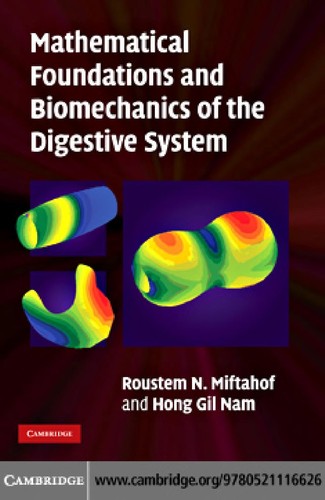
Mathematical Foundations and Biomechanics of the Digestive System
0
0
As an Amazon Associate and affiliate partner, Menrva Books earns from qualifying purchases. Learn more
Author Description
Mathematical modelling of physiological systems promises to advance our understanding of complex biological phenomena and pathophysiology of diseases. In this book, the authors adopt a mathematical approach to characterize and explain the functioning of the gastrointestinal system. Using the mathematical foundations of thin shell theory, the authors patiently and comprehensively guide the reader through the fundamental theoretical concepts, via step-by-step derivations and mathematical exercises, from basic theory to complex physiological models. Applications to nonlinear problems related to the biomechanics of abdominal viscera and the theoretical limitations are discussed. Special attention is given to questions of complex geometry of organs, effects of boundary conditions on pellet propulsion, as well as to clinical conditions, e.g. functional dyspepsia, intestinal dysrhythmias and the effect of drugs to treat motility disorders. With end of chapter problems, this book is ideal for bioengineers and applied mathematicians--Provided by publisher.
Menrva's Summary
THE THESIS
This book investigates the application of mathematical modeling, specifically thin shell theory, to understand the biomechanics and physiological functions of the digestive system. The authors, Roustem Miftahof, guide readers through fundamental theoretical concepts with step-by-step derivations and exercises, progressing from basic theory to complex physiological models. The work addresses nonlinear problems in the biomechanics of abdominal viscera, considering complex organ geometries and boundary condition effects on pellet propulsion. It also explores clinical conditions such as functional dyspepsia, intestinal dysrhythmias, and the impact of drugs on motility disorders.
THE SCOPE MAP
- Mathematical foundations of thin shell theory applied to the gastrointestinal system.
- Step-by-step derivations and mathematical exercises.
- Models for complex physiological phenomena and disease pathophysiology.
- Applications to nonlinear problems in abdominal viscera biomechanics.
- Discussion of clinical conditions: functional dyspepsia, intestinal dysrhythmias.
- Analysis of drug effects on gastrointestinal motility disorders.
- Consideration of complex organ geometries and boundary conditions.
- End-of-chapter problems for bioengineers and applied mathematicians.
THE AUTHORITY PERSPECTIVE
The book is presented as an ideal resource for bioengineers and applied mathematicians seeking to understand the digestive system through mathematical modeling. Its comprehensive approach, from fundamental theory to clinical applications, suggests it is a detailed and rigorous text. The inclusion of end-of-chapter problems indicates a pedagogical intent, aiming to facilitate learning and application of the presented concepts.
Page Count:
0
Publication Date:
2010-01-01
ISBN-10:
0521116627
ISBN-13:
9780521116626
Non-Fiction
Science
Biomechanics
Physiology
Biomedical Engineering
Applied Mathematics
Community Tags
Similar Books