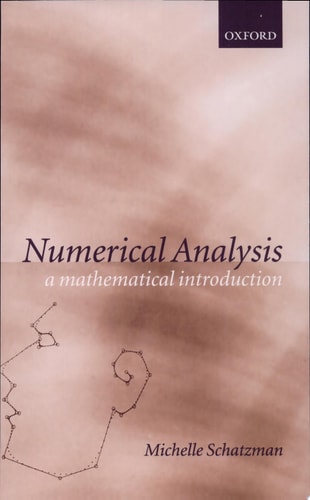
Numerical Analysis: A Mathematical Introduction
0
0
As an Amazon Associate and affiliate partner, Menrva Books earns from qualifying purchases. Learn more
Author Description
This book provides professionals and students with a thorough understanding of the interface between mathematics and scientific computation. Ranging from classical questions to modern techniques, it explains why numerical computations succeed or fail. The book is divided into four sections, with an emphasis on the use of mathematics as a tool in determining the success rate of numerical methods. The text requires only a modest level of mathematical training, and is ideally suited for scientists and students in mathematics, physics and engineering.
Menrva's Summary
THE THESIS
This text investigates the fundamental mathematical principles that determine the efficacy and failure points of numerical computation methods. Michelle Schatzman, an expert in the field, provides a structured framework that bridges the gap between abstract mathematical theory and practical scientific application. By examining both classical problems and contemporary techniques, the book establishes a rigorous foundation for understanding how computational algorithms perform in real-world scenarios.
THE SCOPE MAP
What You Will Find
- A four-part organizational structure covering the spectrum of numerical analysis.
- Mathematical proofs and derivations explaining the success rates of specific algorithms.
- Analytical techniques for evaluating the stability and accuracy of computational models.
- Applications tailored for students and professionals in physics, engineering, and mathematics.
THE AUTHORITY PERSPECTIVE
Experts identify this work as a rigorous, foundational resource for those seeking to understand the underlying mechanics of scientific computation. Readers frequently note that while the text requires a baseline of mathematical knowledge, it remains accessible to students and professionals across technical disciplines.
Page Count:
516
Publication Date:
2002-12-26
Publisher:
Oxford University Press
ISBN-10:
0198508522
ISBN-13:
9780198508526
Engineering
Mathematics
Scientific Computing
Numerical analysis
textbook
Physics
Community Tags
Similar Books