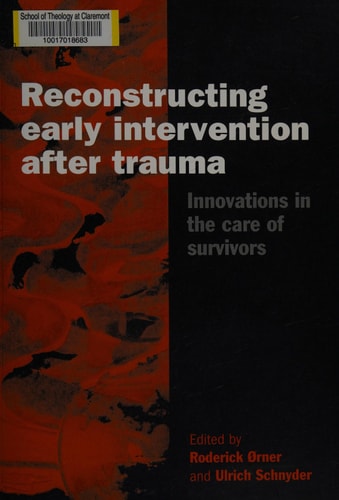
Reconstructing Early Intervention after Trauma: Innovations in the Care of Survivors
0
0
As an Amazon Associate and affiliate partner, Menrva Books earns from qualifying purchases. Learn more
Author Description
The introduction of a diagnosis of Post Traumatic Stress Disorder in the 1980 edition of the American Psychiatric Association's Diagnostic and Statistical Manual for Mental Disorders heralded the dawn of modern psychotraumatology. On the strength of the conceptual refinements offered by this new diagnosis, much consideration has been given to the challenge of effecting early intervention after trauma. To do so offered the prospect of preventing initial reactions developing into a debilitating chronic disorder with comlicating co-morbidities.Some of the original proponents of early intervention protocols have continued to claim that such provision will mitigate the effects of traumatic events, prevent the onset of a traumatic stree syndrome, allow early detection of those who may require further help and help re-establish a homeostatic equilibrium. The evidence base for making these claims has never been made explicit. More recent clinical trials suggest a more qualified position ought to be taken with respect to what should reasonably and reliably claimed for early intervention techniques used to date. More alarming is the growth cluster of studies warning against certain types of intervention.The optimism which once prevailed with respect to what early intervention after trauma might achieve has, in recent years, been replaced by controversy and defensively entrenched posturing.This book aims to provide a comprehensive update on the accumulated experience in the field of early intervention after trauma and defines standards for service provision. It does so by reviewing the historical traditions and theoretical foundations for early interventions and links recommendations for psychological first aid to a substantial body of multidisciplinary evidence. The ultimate aim of this book is to reconstruct an informed evidence base for early intervention after trauma.
Menrva's Summary
THE THESIS
This book investigates the efficacy and clinical validity of early intervention protocols following traumatic events, seeking to reconcile historical optimism with contemporary evidence-based findings. Editors Roderick Orner and Ulrich Schnyder, representing the European Society for Traumatic Stress Studies, compile multidisciplinary research to address the controversy surrounding post-trauma care. The text evaluates whether early psychological intervention prevents the development of chronic disorders or if certain established techniques may inadvertently cause harm. By analyzing the evolution of psychotraumatology since the 1980s, the authors aim to establish a rigorous, evidence-informed standard for future service provision.
THE SCOPE MAP
What You Will Find
- Historical analysis of the development of Post Traumatic Stress Disorder as a clinical diagnosis.
- Critical review of early intervention protocols and psychological first aid techniques.
- Synthesis of clinical trial data and multidisciplinary research regarding trauma recovery.
- Frameworks for defining professional standards in trauma-informed care.
THE AUTHORITY PERSPECTIVE
Experts recognize this volume as a foundational text for clinicians navigating the shift from traditional trauma protocols to evidence-based practice. Professionals frequently cite the work for its balanced approach to the controversies surrounding early intervention and its utility in setting clinical standards.
Page Count:
304
Publication Date:
2003-06-26
Publisher:
Oxford University Press
ISBN-10:
0198508344
ISBN-13:
9780198508342
Psychology
Trauma
Psychiatry
Mental Health
Psychic Trauma
Community Tags
Similar Books