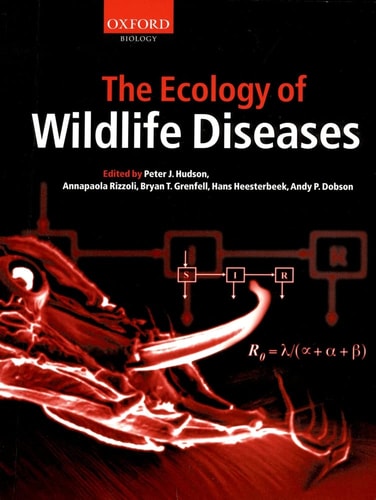
Ecology of Wildlife Diseases
0
0
As an Amazon Associate and affiliate partner, Menrva Books earns from qualifying purchases. Learn more
Author Description
Product Description Recent outbreaks of disease in domestic animals, humans and wildlife illustrate the relative importance of infectious diseases and the vulnerability of susceptible animals. Why do such diseases emerge? What are the factors that lead to dramatic epidemics? How can we apply our knowledge to improve the methods of control? These are just some of the questions addressed in this book, which seeks to develop and apply an ecological approach to an understanding of epidemiology in wild animal populations. The development of mathematical models in the dynamics of infectious diseases is a field that has seen rapid growth over the last decade. There is now a need to challenge these models with the data and to bring vets and field workers closer to the disease issues. This book was conceived to identify the exciting questions and set the future research agenda. 50 of the most active workers met in Trento, northern Italy, to brainstorm the issues, and from this the editors have moulded a synthesis that captures the excitement and importance of this expanding field. About the Author Peter Hudson, Department of Biological Sciences, University of Stirling. Annapaola Rizzoli, Centro di Ecologia Alpina, Trento, Italy. Bryan Grenfell, Department of Zoology, University of Cambridge.
Menrva's Summary
THE THESIS
This book investigates the ecological drivers of infectious disease outbreaks in wild animal populations and the methodologies required to model and control these epidemics. The authors, a group of distinguished researchers in biological sciences and zoology, synthesize current knowledge to bridge the gap between theoretical mathematical modeling and practical field observations. By examining the vulnerability of susceptible species, the text provides a framework for understanding why diseases emerge and how to improve management strategies in natural environments.
THE SCOPE MAP
What You Will Find
- Mathematical modeling techniques for infectious disease dynamics in wildlife.
- Ecological approaches to understanding epidemiology in non-domesticated populations.
- Synthesis of data from a collaborative research summit held in Trento, Italy.
- Strategies for integrating field worker observations with theoretical research agendas.
THE AUTHORITY PERSPECTIVE
Experts recognize this volume as a foundational synthesis that successfully connects abstract epidemiological models with real-world ecological data. Readers frequently note the technical density of the prose, which is intended for researchers, veterinarians, and graduate-level students in the biological sciences.
Page Count:
240
Publication Date:
2002-03-14
Publisher:
Oxford University Press
ISBN-10:
0198506201
ISBN-13:
9780198506201
Science
Animal ecology
Zoology
Ecology
Biology
Epidemiology
Veterinary Medicine
Community Tags
Similar Books