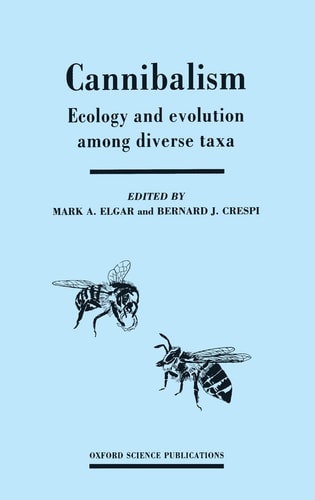
Cannibalism: Ecology and Evolution among Diverse Taxa
0
0
As an Amazon Associate and affiliate partner, Menrva Books earns from qualifying purchases. Learn more
Author Description
Arguing that cannibalism is a straightforward behaviour with far-reaching implications for a species' ecology, life history and evolution, this book covers the contextual and taxonomic diversity of cannibalism and explains its costs, benefits and consequences for a taxonomically broad distribution of species from lower eukaryotes to higher primates. The authors use theory developed for the analysis of foraging, sociality, demography and genetics to assess the ecological and evolutionary causes and effects of cannibalism. The emerging picture from recent research challenges the view that cannibalism is either abnormal behaviour or an infrequent addition to the predator's usual diet.
Menrva's Summary
THE THESIS
This book investigates the ecological and evolutionary drivers of cannibalism, challenging the traditional view that such behavior is merely an abnormal or infrequent occurrence. Bernard J. Crespi synthesizes theoretical frameworks from foraging ecology, sociality, and genetics to demonstrate that cannibalism is a widespread, functional behavior with significant consequences for life history and population dynamics across a vast array of species.
THE SCOPE MAP
What You Will Find
- Analysis of cannibalistic behavior across diverse taxa, ranging from lower eukaryotes to higher primates.
- Theoretical frameworks derived from foraging, sociality, demography, and genetics.
- Examination of the costs, benefits, and evolutionary trade-offs associated with conspecific predation.
- Synthesis of recent research regarding the ecological impact of cannibalism on species survival and population structure.
THE AUTHORITY PERSPECTIVE
Experts recognize this work as a comprehensive synthesis that successfully integrates disparate biological studies into a unified evolutionary context. Readers frequently note the academic density of the prose, which serves as a foundational text for researchers and students interested in behavioral ecology and evolutionary biology.
Page Count:
376
Publication Date:
1992-07-30
Publisher:
Oxford University Press
ISBN-10:
0198546505
ISBN-13:
9780198546504
Science
Animal ecology
Ecology
Biology
Evolutionary Biology
Evolution
Zoology