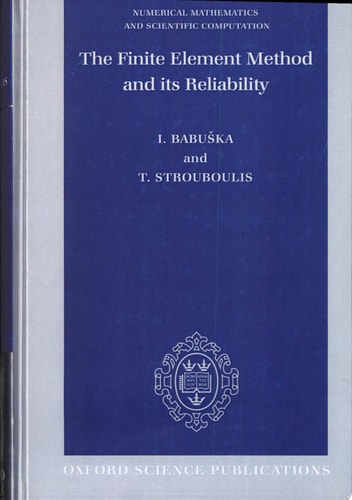
The Finite Element Method and Its Reliability
0
0
As an Amazon Associate and affiliate partner, Menrva Books earns from qualifying purchases. Learn more
Author Description
The finite element method is a numerical method widely used in engineering. Experience shows that unreliable computation can lead to very serious consequences. Hence reliability questions stand are at the forefront of engineering and theoretical interests. This book presents the mathematical theory of the finite element method and is the first to focus on the questions of how reliable computed results really are. It addresses among other topics the local behaviour, errors caused by pollution, superconvergence, and optimal meshes. Many computational examples illustrate the importance of the theoretical conclusions for practical computations. Graduate students, lecturers, and researchers in mathematics, engineering, and scientific computation will benefit from the clear structure of the book, and will find this a very useful reference.
Menrva's Summary
THE THESIS
This book investigates the critical question of how to ensure the reliability and accuracy of numerical results produced by the finite element method in engineering applications. Authors Ivo Babuska and Theofanis Strouboulis, both established experts in numerical analysis, provide a rigorous mathematical framework to evaluate computational errors. They argue that understanding the theoretical underpinnings of the method is essential to preventing catastrophic failures in practical engineering scenarios.
THE SCOPE MAP
What You Will Find
- Mathematical theory of the finite element method
- Analysis of local behavior and pollution errors
- Techniques for superconvergence and optimal mesh generation
- Computational examples demonstrating theoretical conclusions
THE AUTHORITY PERSPECTIVE
Experts recognize this work as a foundational text for understanding the limitations and error bounds of finite element analysis. Readers frequently note the high level of mathematical rigor, making it a primary reference for graduate-level researchers and practitioners in scientific computation.
Page Count:
736
Publication Date:
2001-12-15
Publisher:
Oxford University Press
ISBN-10:
0198502761
ISBN-13:
9780198502760
Mathematics
Numerical analysis
Engineering
Community Tags
Similar Books