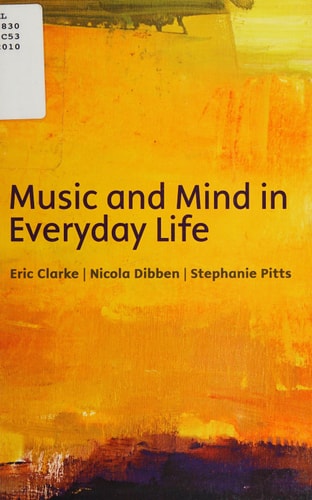
Music and Mind in Everyday Life
0
0
As an Amazon Associate and affiliate partner, Menrva Books earns from qualifying purchases. Learn more
Author Description
Music pervades everyday life - in homes, on trains and planes, in cars and shops, at births and deaths, at weddings and war, in concert halls, clubs, stadiums, and fields. In so many ways, music marks and orchestrates the ways in which people experience the world together. What is it that makes people want to live their lives to the sound of music, and why do so many of our most private experiences and most public spectacles incorporate - or even depend on - music?Music and Mind in Everyday Life uses psychology to understand musical behaviour and experience in a range of circumstances, including composing and performing, listening and persuading, and teaching and learning. Starting from 'real world' examples of musical experiences, it critically examines the ways in which psychology can explain people's diverse experience of, and engagement with music, focusing on how music is used, acquired, and made in a range of familiar musical contexts. Using a framework of real and imagined musical scenarios, the book draws on a wide range of research in the psychology of music and music education.The book is organized into three central sections. In "Making Music," it tackles the psychology of playing, improvising, and composing music, understood as closely related and integrated activities. In Using Music the authors address the ways in which people listen to music, manage their emotions, moods, and identities with music, and use music for therapy, persuasion and social control. In "Acquiring Music," they consider music in human development, and in a range of more formal and informal educational contexts. The final chapter provides an overview of the history and preoccupations of music psychology as a discipline, and concludes with some remarks on the wider significance of music psychology for an understanding of human subjectivity.Drawing on a wide range of research in music psychology and music education, the book will make fascinating reading for musicians and music schol
Menrva's Summary
THE THESIS
This book investigates the psychological mechanisms that explain why music is an integral component of human experience and social behavior. The authors, Eric F. Clarke, Nicola Dibben, and Stephanie Pitts, utilize a framework grounded in music psychology and education to analyze how individuals engage with music across diverse real-world contexts. By synthesizing research on human development, emotional regulation, and social interaction, they argue that music is not merely an aesthetic pursuit but a fundamental aspect of human subjectivity and social organization.
THE SCOPE MAP
What You Will Find
- Analysis of musical behavior in everyday environments ranging from private homes to public spectacles.
- Examination of the psychological processes involved in composing, improvising, and performing music.
- Investigation into how music functions in emotional regulation, identity formation, and social control.
- Overview of the history and disciplinary development of music psychology as a field of study.
THE AUTHORITY PERSPECTIVE
Experts and academics recognize this work as a comprehensive introduction to the intersection of cognitive psychology and musical practice. Readers frequently note the accessible yet rigorous approach, making it a foundational text for students and professionals in music education and psychology.
Page Count:
224
Publication Date:
2009-12-20
Publisher:
Oxford University Press
ISBN-10:
0198525575
ISBN-13:
9780198525578
Psychology
Music
Non-Fiction
Music Education
Music
Community Tags
Similar Books





Reader Comments
Share Your Thoughts
No comments yet. Be the first to share your thoughts!