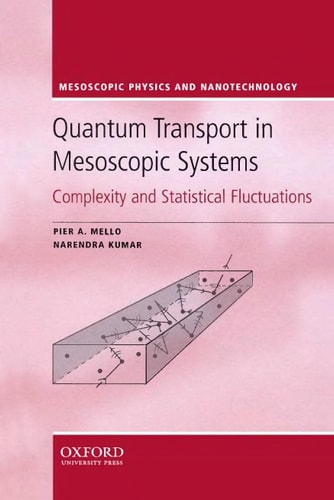
Quantum Transport in Mesoscopic Systems: Complexity and Statistical Fluctuations
0
0
As an Amazon Associate and affiliate partner, Menrva Books earns from qualifying purchases. Learn more
Author Description
This book presents the statistical theory of complex wave scattering and quantum transport in physical systems which have chaotic classical dynamics, as in the case of microwave cavities and quantum dots, or which possess quenched randomness, as in the case of disordered conductors - with an emphasis on mesoscopic fluctuations. The statistical regularity of the phenomena is revealed in a natural way by adopting a novel maximum-entropy approach. Shannon's information entropy is maximised, subject to the symmetries and constraints which are physically relevant, within the powerful and non-perturbative theory of random matrices; this is a most distinctive feature of the book. Aiming for a self-contained presentation, the quantum theory of scattering, set in the context of quasi-one-dimensional, multichannel systems, and related directly to scattering problems in mesoscopic physics, is introduced in chapters two and three. The linear-response theory of quantum electronic transport, adapted to the context of mesoscopic systems, is discussed in chapter four. These chapters, together with chapter five on the maximum-entropy approach and chapter eight on weak localization, have been written in a most pedagogical style, suitable for use on graduate courses. In chapters six and seven, the problem of electronic transport through classically chaotic cavities and quasi-one-dimensional disordered systems is discussed. Many exercises are included, most of which are worked through in detail, aiding graduate students, teachers, and research scholars interested in the subject of quantum transport through disordered and chaotic systems.
Menrva's Summary
THE THESIS
This book investigates the statistical theory of complex wave scattering and quantum transport in systems characterized by chaotic classical dynamics or quenched randomness. Authors Narendra Kumar and Pier A. Mello utilize a maximum-entropy approach, grounded in Shannon's information entropy and random matrix theory, to provide a non-perturbative framework for understanding mesoscopic fluctuations. The text synthesizes quantum scattering theory with linear-response transport theory to address the behavior of quasi-one-dimensional, multichannel systems. By applying these mathematical constraints to physical symmetries, the authors establish a rigorous methodology for analyzing disordered conductors and chaotic cavities.
THE SCOPE MAP
What You Will Find
- Theoretical framework for quantum electronic transport in mesoscopic systems.
- Application of maximum-entropy methods and random matrix theory to wave scattering.
- Analysis of weak localization and transport through classically chaotic cavities.
- Pedagogical exercises with detailed solutions for graduate-level study.
THE AUTHORITY PERSPECTIVE
Experts identify this text as a specialized resource for graduate students and researchers focusing on the intersection of chaos theory and condensed matter physics. Readers frequently note the high level of mathematical rigor and the pedagogical utility of the included problem sets.
Page Count:
416
Publication Date:
2004-07-15
Publisher:
Oxford University Press
ISBN-10:
0198525826
ISBN-13:
9780198525820
Science
Nanotechnology
Academic
Physics
Community Tags
Similar Books