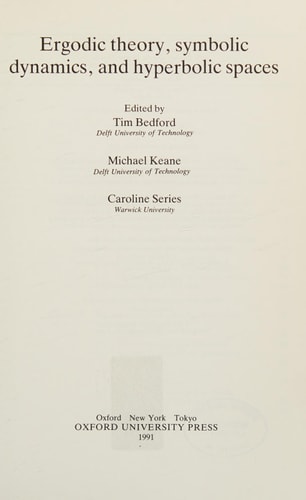
Ergodic Theory, Symbolic Dynamics, and Hyperbolic Spaces
0
0
As an Amazon Associate and affiliate partner, Menrva Books earns from qualifying purchases. Learn more
Author Description
This textbook provides an introductory survey to the interaction between ergodic theory and hyperbolic geometry intended for postgraduate students coming to these subjects for the first time. The aim of the volume is to explore the interplay between the two subjects and to present some of the new directions that research has taken. The chapters are all written by specialists in their respective fields and the editors have gone to great pains to ensure that the volume as a whole provides an accessible and up-to-date introduction to a very active area of research. As a result it should prove valuable to all those embarking on research in this subject as well as for those whose current research touches on topics covered here. Prerequisites are little more than a familiarity with the basics of topology, analysis, and group theory as might be gained from an undergraduate degree course. Early chapters present an introduction to the fundamental concepts of hyperbolic geometry and ergodic theory. Subsequent chapters develop more advanced topics such as explicit coding methods, symbolic dynamics, the theory of nuclear operators as applied to the Ruelle-Perron-Frobenius (or transfer) operator, the Patterson measure, and the connections with finiteness phenomena in the structure of hyperbolic spaces.
Menrva's Summary
THE THESIS
This volume investigates the mathematical interplay between ergodic theory and hyperbolic geometry to provide a cohesive framework for postgraduate research. The editors, Caroline Series, Michael Keane, and Tim Bedford, have compiled contributions from field specialists to bridge the gap between foundational concepts and contemporary research directions. By assuming only undergraduate-level familiarity with topology, analysis, and group theory, the text serves as a structured introduction to the complex dynamics governing hyperbolic spaces.
THE SCOPE MAP
What You Will Find
- Fundamental concepts of hyperbolic geometry and ergodic theory
- Explicit coding methods and symbolic dynamics
- Theory of nuclear operators applied to the Ruelle-Perron-Frobenius operator
- Analysis of the Patterson measure and finiteness phenomena in hyperbolic structures
THE AUTHORITY PERSPECTIVE
Experts recognize this volume as a foundational resource for students and researchers entering the intersection of these two mathematical fields. Readers frequently note the technical density of the prose, which is balanced by the editors' commitment to maintaining accessibility for postgraduate-level study.
Page Count:
388
Publication Date:
1991-05-09
Publisher:
Oxford University Press
ISBN-10:
019853390X
ISBN-13:
9780198533900
Geometry
Mathematics
Topology
textbook
Ergodic Theory
Academic
Community Tags
Similar Books