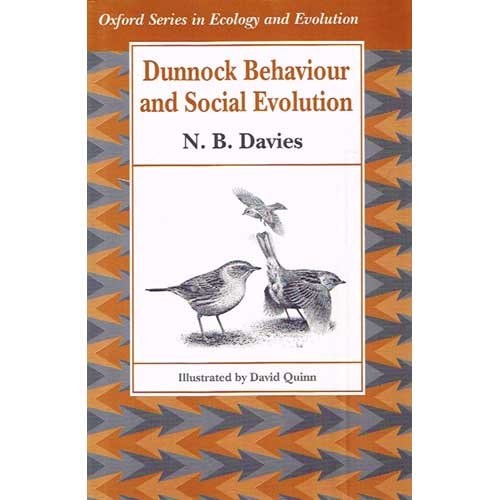
Dunnock Behaviour and Social Evolution (Oxford Series in Ecology and Evolution)
0
0
As an Amazon Associate and affiliate partner, Menrva Books earns from qualifying purchases. Learn more
Author Description
At first sight just a small brown bird, the dunnock's unobtrusive appearance belies its extraordinary behaviour and mating patterns. In this book Nick Davies gives a full account of the mating systems of the dunnock or hedge sparrow, Prunella modularis, which include pairs, a male with two females, two males with one female, and several males with several females. Detailed observations, elegant field experiments, and DNA fingerprinting are combined to show how this variable social organization arises from selfish individuals competing to maximize their own reproductive success. Further experiments reveal how the cuckoo may thwart the dunnock's parental efforts. David Quinn's exquisite drawings provide a visual summary of the birds' behaviour. All students of ecology, evolution, and animal behaviour will want to be familiar with this work, which addresses the wider issues of the influence of ecology on mating systems and the evolutionary significance of conflict within and between species. This is the third volume in the Oxford Series in Ecology and Evolution, and the first in this series to tackle behavioural ecology. Nick Davies is a Lecturer in Zoology at the University of Cambridge and co-editor with J.R. Krebs of the leading text in the field, Behavioural Ecology: An Evolutionary Approach.
Menrva's Summary
THE THESIS
This work investigates how ecological factors and individual competition drive the diverse and complex mating systems observed in the dunnock, Prunella modularis. Nick Davies, a lecturer in zoology at the University of Cambridge, synthesizes years of field research to explain why these birds exhibit such varied social structures, ranging from monogamy to complex polygynandry. By applying principles of behavioral ecology, the author demonstrates that these mating patterns are not random but are the result of individuals acting to maximize their own reproductive success within specific environmental constraints.
THE SCOPE MAP
What You Will Find
- Comprehensive analysis of dunnock mating systems including monogamy, polygyny, polyandry, and polygynandry.
- Integration of field observations, controlled experiments, and DNA fingerprinting data.
- Examination of interspecies conflict, specifically the impact of cuckoo parasitism on dunnock parental care.
- Theoretical framework linking ecological variables to the evolution of social organization.
THE AUTHORITY PERSPECTIVE
Experts recognize this volume as a foundational text in the field of behavioral ecology, frequently cited for its rigorous methodology and clear synthesis of complex evolutionary concepts. Students and researchers alike value the text for its ability to bridge the gap between detailed field observations and broader evolutionary theory.
Page Count:
288
Publication Date:
1992-09-24
Publisher:
Oxford University Press
ISBN-10:
0198546742
ISBN-13:
9780198546740
Science
Zoology
Ecology
Evolutionary Biology
Ornithology
Community Tags
Similar Books