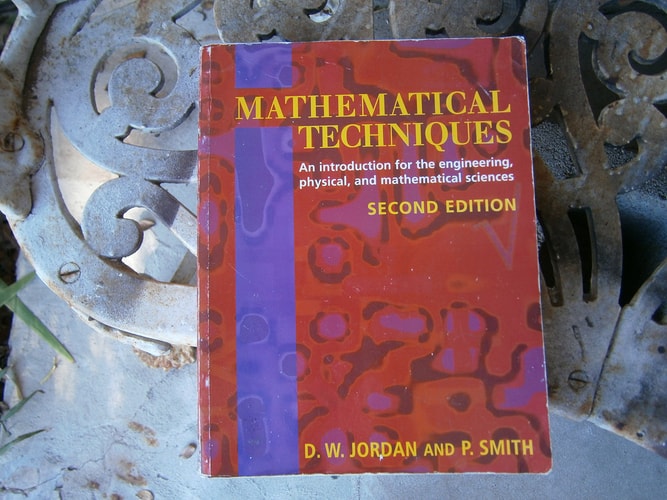
Mathematical Techniques: An Introduction for the Engineering, Physical, and Mathematical Sciences
0
0
As an Amazon Associate and affiliate partner, Menrva Books earns from qualifying purchases. Learn more
Author Description
Undergraduate students of engineering, science, and mathematics must quickly master a variety of mathematical methods, although many of these students do not have strong mathematics backgrounds. In this well-received book, now in its second edition, the authors use their extensive experience with diverse groups of students to provide an accessible introduction to mathematical techniques. They start at the elementary level and proceed to cover the full range of topics typically encountered by beginning students:BL Analytic geometry, vector algebra, vector fields (div and curl), differentiation, and integration.BL Complex numbers, matrix operations, and linear systems of equations.BL Differential equations and first-order linear systems, functions of more than one variable, double integrals, and line integrals.BL Laplace transforms, Fourier series and Fourier transforms.BL Probability and statistics.Incorporating many suggestions from readers, this new edition has expanded discussions of vectors and new chapters on Fourier series and on probability and statistics. The emphasis throughout is on understanding concepts through well-chosen examples, and the book includes over 500 fully worked problems. As far as is possible chapter topics are self-contained so that a student only needing to master certain techniques can omit others without trouble. The generously illustrated text also includes simple numerical processes which lead to examples and projects for computation (particularly with Mathematica), and contains a large number of exercises (with answers) to reinforce the material. These features combine to make this book an ideal starting point for students entering the sciences.
Menrva's Summary
THE THESIS
This book investigates the fundamental mathematical methods required for undergraduate students in engineering, physical, and mathematical sciences to succeed in their respective fields. Authors D. W. Jordan and P. Smith leverage their extensive pedagogical experience to bridge the gap for students who may lack a strong mathematical foundation. The text provides a structured, accessible framework that transitions from elementary concepts to advanced analytical techniques, ensuring that learners can grasp complex operations through clear, practical application.
THE SCOPE MAP
What You Will Find
- Comprehensive coverage of analytic geometry, vector algebra, and vector fields including divergence and curl.
- Detailed instruction on matrix operations, linear systems, and differential equations.
- Advanced topics including Laplace transforms, Fourier series, and Fourier transforms.
- Practical application through over 500 fully worked problems, numerical processes, and computational projects.
THE AUTHORITY PERSPECTIVE
Experts and educators frequently highlight this text as a foundational resource for students transitioning into rigorous scientific curricula. Readers often note the clarity of the prose and the self-contained nature of the chapters, which allows for flexible study paths.
Page Count:
808
Publication Date:
1997-11-06
Publisher:
Oxford University Press
ISBN-10:
0198564619
ISBN-13:
9780198564614
Science
Linear Algebra
Mathematics
Engineering
Calculus
Mathematical Analysis
textbook
Community Tags
Similar Books