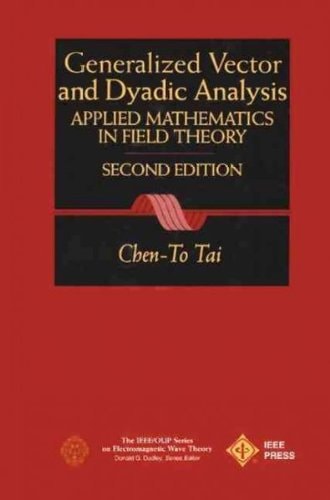
Generalized Vector and Dyadic Analysis: Applied Mathematics in Field Theory
0
0
As an Amazon Associate and affiliate partner, Menrva Books earns from qualifying purchases. Learn more
Author Description
Product Description An indispensible reference tool for engineers, mathematicians, and physicists, this book describes in detail previously unpublished methods for treating and presenting vector and dyadic analysis. Along with pointing out a number of fundamental misunderstandings, the author presents originalwork on a new symbolic method with the aid of a symbolic vector. For this revision of the 1992 edition, the author has added a chapter explaining the confusion that usually arises from misinterpretation of Gibbs' notation for divergence and curl. He has also expanded his discussion of the use of the symbolic vector in the general non-orthogonal curvilinearsystem. This concise and rigorous book employs the symbolic vector for a systematic treatment of the entire subject of vector analysis and includes the derivation of new vector theorems and vector and dyadic identities. It is an approach ideal for graduate-level students in eletromagnetic engineering,physics, and mathematics. About the Author Chen-To Tai, Professor Emeritus, Department of Electrical Engineering and Computer Science, University of Michigan.
Menrva's Summary
THE THESIS
This text investigates the mathematical foundations of vector and dyadic analysis to resolve common misinterpretations in field theory applications. Chen-To Tai, a Professor Emeritus at the University of Michigan, draws upon his extensive background in electrical engineering to provide a rigorous, systematic treatment of the subject. By introducing a novel symbolic method and clarifying the notation used in divergence and curl operations, the author provides a framework designed to correct historical misunderstandings in the field.
THE SCOPE MAP
What You Will Find
- Systematic treatment of vector and dyadic analysis using symbolic vector methods
- Derivation of new vector theorems and identities
- Analysis of general non-orthogonal curvilinear systems
- Clarification of Gibbs' notation for divergence and curl
THE AUTHORITY PERSPECTIVE
Experts and graduate-level students frequently identify this work as a rigorous, specialized reference for those working in electromagnetic engineering and theoretical physics. Readers often note the high level of technical density, making it a foundational text for those seeking to master the nuances of dyadic analysis.
Page Count:
224
Publication Date:
2099-11-30
Publisher:
Oxford University Press
ISBN-10:
0198565461
ISBN-13:
9780198565468
Field Theory
Engineering
Vector analysis
Mathematics
Physics
Community Tags
Similar Books