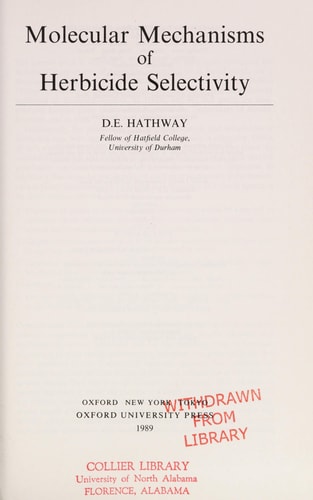
Molecular Mechanisms of Herbicide Selectivity
0
0
As an Amazon Associate and affiliate partner, Menrva Books earns from qualifying purchases. Learn more
Author Description
Because plants of different species vary in the way in which they take up, transport, and metabolize chemicals in the soil, selective herbicides can be synthesized. This book examines those aspects of plant physiology, principally in crop plants, which can be affected by herbicides; the possibilities that are offered by recombinant DNA technology for developing resistance to herbicides; and methods for exploiting or preventing acquired tolerance. The author also covers recent work on ultra-selective mycoherbicides and the use of allelochemicals as herbicide substitutes.
Menrva's Summary
THE THESIS
This book investigates the physiological and biochemical mechanisms that allow for the development and application of selective herbicides in agricultural settings. D. E. Hathway, an expert in chemical toxicology and plant science, synthesizes existing research on how plant species differentially uptake, transport, and metabolize chemical compounds. The text provides a framework for understanding how these variations can be exploited to create targeted weed control solutions while minimizing damage to crop plants.
THE SCOPE MAP
What You Will Find
- Analysis of plant physiological responses to chemical exposure in various crop species.
- Evaluation of recombinant DNA technology applications for engineering herbicide resistance.
- Examination of ultra-selective mycoherbicides as a modern control method.
- Discussion on the role of allelochemicals as potential substitutes for traditional herbicides.
THE AUTHORITY PERSPECTIVE
Experts recognize this work as a technical resource for understanding the biochemical basis of herbicide selectivity. Readers frequently note the academic density of the prose, which is intended for researchers and students in agricultural chemistry and plant physiology.
Page Count:
224
Publication Date:
1989-08-24
Publisher:
Oxford University Press
ISBN-10:
0198576420
ISBN-13:
9780198576426
Science
Agriculture
Botany
Herbicides
Chemistry
Biology
Community Tags
Similar Books