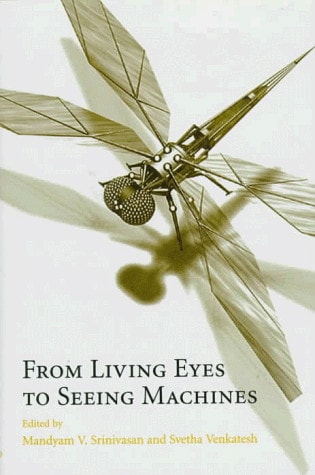
From Living Eyes to Seeing Machines
0
0
As an Amazon Associate and affiliate partner, Menrva Books earns from qualifying purchases. Learn more
Author Description
Anyone who has watched a kangaroo bounding rapidly through a dense forest, or seen a falcon swooping down to catch a field mouse knows that the animal kingdom has evolved fast, reliable, and precise visual systems. A fly evading a swat and executing a flawless landing on the rim of a teacup is the result of such a system. If animals are using clever short-cuts to vision and navigation, can they be exploited for other applications, such as robot design and novel algorithms? This book explores that possibility; the articles, written by scientists from evolutionary biology to computer science, are written with minimal technical jargon and invite a fresh approach to an area normally dominated by engineering methods.
Menrva's Summary
THE THESIS
This book investigates whether the highly evolved visual and navigational systems found in the animal kingdom can be adapted to improve robot design and computational algorithms. The editors, Mandyam V. Srinivasan and Venkatesh S., compile contributions from a diverse group of scientists spanning evolutionary biology and computer science. By examining how animals execute complex maneuvers like high-speed flight and precise landing, the authors argue that biological shortcuts offer viable, efficient alternatives to traditional engineering-heavy approaches in robotics.
THE SCOPE MAP
What You Will Find
- Comparative analysis of animal visual systems and artificial vision sensors
- Case studies on insect flight mechanics and navigation
- Methodologies for translating biological behavioral patterns into robotic control algorithms
- Interdisciplinary perspectives on evolutionary biology and machine learning
THE AUTHORITY PERSPECTIVE
Experts and readers alike note that this text successfully bridges the gap between biological observation and practical engineering application. The prose is praised for its accessibility, making complex interdisciplinary concepts understandable for those outside of specialized fields.
Page Count:
288
Publication Date:
1997-07-10
Publisher:
Oxford University Press
ISBN-10:
0198577850
ISBN-13:
9780198577850
Science
Computer Science
Vision
Evolutionary Biology
Technology
Biology
Robotics
Community Tags
Similar Books