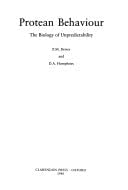
Protean Behaviour: The Biology of Unpredictability
0
0
As an Amazon Associate and affiliate partner, Menrva Books earns from qualifying purchases. Learn more
Author Description
The result of twenty-five years of research, this highly original book explores the problem of unpredictable or protean behavior as it is commonly observed in wildlife. How can randomness be of advantage to an animal? The authors describe, classify, and analyze a variety of animal behaviors, showing that apparent randomness is, upon closer scrutiny, only unpredictable enough to confuse the animal's enemies. Thus, seemingly erratic behavior is truly to an advantage. The authors establish the concept of "systematic unpredictability", and discuss evolutionary aspects of the phenomenon and its wider implications--beyond simple escape movements of prey and "crazy dances" of predators. This fascinating book will bring new insights into many aspects of behavioral science, natural history, biology, and psychology.
Menrva's Summary
THE THESIS
How does the evolution of unpredictable behavior provide a survival advantage to animals in predator-prey interactions? The authors, D. A. Humphries and P. M. Driver, synthesize twenty-five years of observational research to argue that what appears to be random movement is actually a calculated, systematic strategy. By analyzing the mechanics of erratic motion, they demonstrate that such behavior functions as a defensive mechanism designed to disrupt the predictive capabilities of an adversary.
THE SCOPE MAP
What You Will Find
- A classification system for various types of erratic animal movements and behaviors.
- Analysis of the evolutionary pressures that favor unpredictable responses in prey.
- Examination of the 'crazy dances' and erratic patterns observed in predator-prey dynamics.
- Theoretical framework for 'systematic unpredictability' as a biological adaptation.
THE AUTHORITY PERSPECTIVE
Experts recognize this work as a foundational text for understanding the strategic utility of randomness in behavioral biology. Readers frequently note the academic density of the prose, which serves as a rigorous examination of evolutionary tactics.
Page Count:
360
Publication Date:
1988-12-29
Publisher:
Oxford University Press
ISBN-10:
0198571704
ISBN-13:
9780198571704
Psychology
Science
Natural History
Biology
Evolutionary Biology
Community Tags
Similar Books