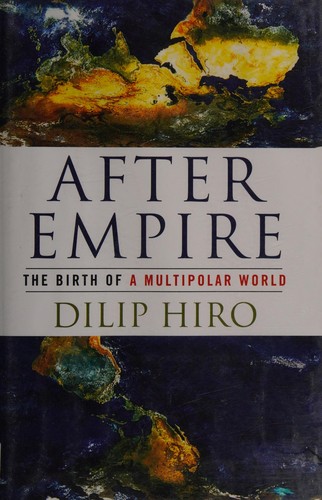
After Empire
0
0
As an Amazon Associate and affiliate partner, Menrva Books earns from qualifying purchases. Learn more
Author Description
The United States' victory in the Cold War in 1991 led to triumphalist claims that humanity had reached "the end of history," and that Washington would enjoy everlasting supremacy. U.S. Secretary of State Madeleine Albright called America "the indispensable nation." By invading Iraq, George W. Bush undermined U.S. credibility worldwide. By curtailing Americans' civil liberties while waging an endless "war on terror," and resorting to torture in prisons of occupied Iraq, Afghanistan, and Guantánamo Bay, his administration, as well as America, lost its claim to a moral high ground. Moreover, the 2008-2009 global fiscal meltdown, triggered by sub-prime mortgage crisis on Wall Street, exposed that heavily indebted America had ceased to be the financial behemoth it had been since World War II. After Empire sketches complex world system emerging during late imperial phase of U.S.^ It examines events that prepared the ground for world to move from the tutelage of the sole superpower, America, to a multipolar, post-imperial global order. Author Dilip Hiro does so from a distinctly non-Western perspective. Dilip Hiro does not offer a comforting thesis that the U.S. is quite capable of accommodating the rising world powers like China, Russia, India, and the European Union while retaining its dominant position. Neither does he frame global politics in a Manichean way - America versus China; the West against Asia. The world, he suggests, is set to revisit the pre-World War I Europe, where rulers frequently changed allies and adversaries to achieve shared aim of keeping the continent free of an overarching power. China's state-owned corporations are buying up companies worldwide. Russia, the number one producer of natural gas, is now world's foremost producer of hydrocarbons. Its nuclear arsenal is on par with America's.^ Venezuela and Iran are challenging Washington-dominated status quo respectively in South America and Middle East. The European Union has surpassed America as
Menrva's Summary
THE THESIS
The United States' post-Cold War unipolar dominance is being challenged by a complex, multipolar world order. The book examines the events and shifts that have led to this transition, moving away from American tutelage towards a global landscape where powers like China, Russia, India, and the European Union are asserting their influence. It analyzes the decline of U.S. credibility following the Iraq invasion and the
THE SCOPE MAP
- Analysis of the U.S.'s post-Cold War triumphalism and claims of everlasting supremacy.
- Examination of how the invasion of Iraq and the "war on terror" undermined U.S. credibility and moral standing.
- Discussion of the 2008-2009 global fiscal meltdown and its impact on America's financial standing.
- Exploration of the emerging multipolar global order and the rise of powers like China, Russia, India, and the EU.
- Analysis of China's global corporate expansion and Russia's position as a leading hydrocarbon producer.
- Discussion of challenges to the U.S.-dominated status quo by nations like Venezuela and Iran.
- A non-Western perspective on global politics, avoiding a simple West vs. Asia dichotomy.
- Comparison of the current global landscape to pre-World War I Europe, characterized by shifting alliances.
THE AUTHORITY PERSPECTIVE
Dilip Hiro's "After Empire" offers a critical examination of the United States' declining global influence from a non-Western viewpoint. The book analyzes key events, such as the Iraq War and the 2008 financial crisis, that have eroded American credibility and paved the way for a multipolar world. It suggests a return to a more fluid international system, reminiscent of pre-World War I Europe, where alliances shift and no single power dominates. The work is noted for its departure from comforting narratives of American adaptability and its avoidance of simplistic East-West confrontations.
Page Count:
352
Publication Date:
2012-01-01
ISBN-10:
1568587139
ISBN-13:
9781568587134
Non-Fiction
History
Politics
Current Events
Geopolitics
International relations
Community Tags
Other Editions(2)
Similar Books






Reader Comments
Share Your Thoughts
No comments yet. Be the first to share your thoughts!