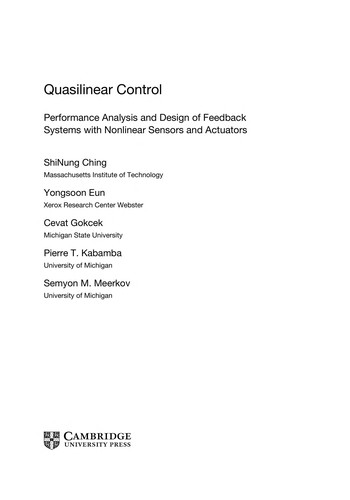
Quasilinear Control
0
0
As an Amazon Associate and affiliate partner, Menrva Books earns from qualifying purchases. Learn more
Author Description
This is a textbook and reference for readers interested in quasilinear control (QLC). QLC is a set of methods for performance analysis and design of linear plant or nonlinear instrumentation (LPNI) systems. The approach of QLC is based on the method of stochastic linearization, which reduces the nonlinearities of actuators and sensors to quasilinear gains. Unlike the usual - Jacobian linearization - stochastic linearization is global. Using this approximation, QLC extends most of the linear control theory techniques to LPNI systems. A bisection algorithm for solving these equations is provided. In addition, QLC includes new problems, specific for the LPNI scenario. Examples include Instrumented LQR/LQG, in which the controller is designed simultaneously with the actuator and sensor, and partial and complete performance recovery, in which the degradation of linear performance is either contained by selecting the right instrumentation or completely eliminated by the controller boosting
Menrva's Summary
THE THESIS
This book explores the application of quasilinear control (QLC) methods to linear plant or nonlinear instrumentation (LPNI) systems. QLC, developed by ShiNung Ching, utilizes stochastic linearization to approximate nonlinearities in actuators and sensors with quasilinear gains, offering a global approximation unlike Jacobian linearization. This technique extends established linear control theory principles to LPNI systems, providing a robust framework for performance analysis and design. The text also introduces a bisection algorithm for solving the relevant equations and addresses specific LPNI challenges, such as Instrumented LQR/LQG and performance recovery strategies.
THE SCOPE MAP
- Methods for performance analysis and design of Linear Plant or Nonlinear Instrumentation (LPNI) systems.
- Application of stochastic linearization to reduce nonlinearities to quasilinear gains.
- Extension of linear control theory techniques to LPNI systems.
- A bisection algorithm for solving QLC equations.
- Discussion of specific LPNI problems like Instrumented LQR/LQG.
- Analysis of partial and complete performance recovery in control systems.
THE AUTHORITY PERSPECTIVE
This textbook serves as a comprehensive reference for those interested in quasilinear control (QLC) methods. The approach is noted for its ability to extend linear control theory to nonlinear systems through stochastic linearization. Readers can expect detailed explanations of the methodology, including algorithms for practical implementation. The inclusion of specific examples like Instrumented LQR/LQG and performance recovery strategies makes it a valuable resource for engineers and researchers in the field.
Page Count:
0
Publication Date:
2010-01-01
ISBN-10:
1107000564
ISBN-13:
9781107000568
Science
Non-Fiction
Control Theory
Engineering
Mathematics
Community Tags
Similar Books