The Six-Cornered Snowflake
0
0
As an Amazon Associate and affiliate partner, Menrva Books earns from qualifying purchases. Learn more
Author Description
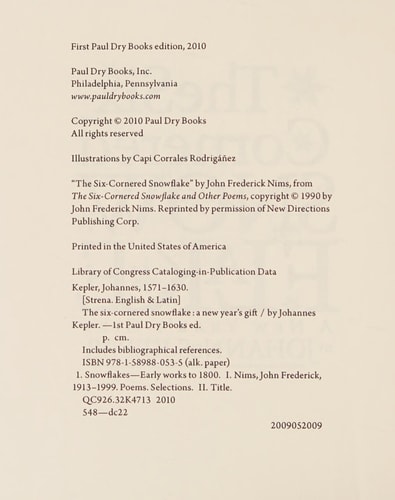
In 1611, the famous astronomer Johannes Kepler wrote The Six-Cornered Snowflake, which was the first scientific reference to snow crystals. Kepler wondered why snow crystals always exhibit a six-fold symmetry. It would be three hundred years before his question could finally be answered, but in the process of failing to solve its mystery, The Six-Cornered Snowflake raises a remarkable number of deeply significant questions in physics, mathematics, and biology. This small work is the first recorded step toward a mathematical theory of the genesis of inorganic or organic forms. Beneath its humor and allusive style, it displays a scientific judgment of the highest caliber. In musing on the hexagonal structure of snowflakes, Kepler in effect challenged those who followed him to discover the mathematics of the emergence of visible forms in crystals, plants, and animals. This Paul Dry Books edition makes a perfect gift, enhanced with illustrations, a fresh translation from the Latin, and introductory essays. Johannes Kepler (1571-1631) was an important figure in the seventeenth-century astronomical revolution. He is best known for his eponymous laws of planetary motion. Kepler “If there is anything that can bind the heavenly mind of man to this dusty exile of our earthly home... then it is verily the enjoyment of the mathematical sciences and astronomy.”
Menrva's Summary
THE THESIS
Johannes Kepler investigates the fundamental geometric question of why snowflakes consistently exhibit a six-fold symmetry. As a foundational figure in the seventeenth-century astronomical revolution, Kepler applies his rigorous analytical mind to the physical world, moving beyond celestial mechanics to examine the structural patterns of terrestrial matter. The text serves as an early inquiry into the mathematical principles that govern the formation of both inorganic and organic structures in nature.
THE SCOPE MAP
What You Will Find
- An early scientific analysis of crystal formation and hexagonal symmetry.
- Philosophical musings on the relationship between mathematical order and the physical world.
- A historical perspective on the development of crystallography and structural biology.
- Commentary on the emergence of visible forms in nature, including plants and animals.
THE AUTHORITY PERSPECTIVE
Experts recognize this work as a foundational text that bridges the gap between early modern philosophy and the birth of mathematical biology. Readers frequently note the accessible yet allusive nature of the prose, which highlights Kepler's unique ability to blend scientific inquiry with intellectual curiosity.
Page Count:
92
Publication Date:
1966-01-01
Publisher:
Oxford University Press
ISBN-10:
0198581203
ISBN-13:
9780198581208
Science
Nature
Physics
Mathematics
Community Tags
Other Editions(4)


Similar Books