Author Description
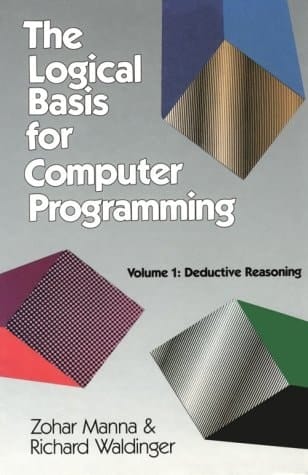
This book is an introduction to the essential ideas of formal logic and to the new field of logic programming, which is beginning to have an impact on the traditional area of conventional software engineering. Logical concepts and how they may be implemented in the logic programming language Prolog are emphasized. The authors discuss parsers, pretty-printers, programming language interpreters, interactive proof-checkers, theorem-provers of various kinds, and implements versions of Prolog. The early part of the book deals with Prolog as a programming language, and how it can be used. The core of the book deals with the propositional and predicate calculi, which are treated conventionally, via natural deduction systems. The theory behind automatic theorem-proving is sketched. The last two chapters examine the logic of a specified small programming imperative language and the restricted logic of real Prolog. Philosophical questions are also considered.
Menrva's Summary
THE THESIS
This book investigates the intersection of formal logic and logic programming, specifically exploring how logical concepts can be implemented through the Prolog language. Peter Gibbins provides a structured introduction to these fields, drawing on his background in computing science to bridge the gap between theoretical propositional and predicate calculi and practical software engineering applications. The text argues that understanding the underlying logic is essential for developing robust interpreters, theorem-provers, and proof-checkers.
THE SCOPE MAP
What You Will Find
- Implementation of parsers, pretty-printers, and interactive proof-checkers
- Conventional treatment of propositional and predicate calculi via natural deduction
- Theoretical foundations of automatic theorem-proving
- Analysis of imperative programming language logic and the specific constraints of Prolog
THE AUTHORITY PERSPECTIVE
Experts identify this text as a foundational resource for those seeking to understand the theoretical underpinnings of logic programming. Readers frequently note the academic density of the prose, which balances philosophical inquiry with technical implementation details.
Page Count:
336
Publication Date:
1988-12-08
Publisher:
Oxford University Press
ISBN-10:
0198596596
ISBN-13:
9780198596592
Logic
Mathematics
Programming
textbook
Computer Science
Community Tags
Similar Books